The Hardware Race: How Do You Actually Build a Qubit?
Superconducting, trapped-ion, photonic, neutral-atom, and topological qubits explained, with the trade-offs, and why qubit count alone tells you little.
Key Takeaways
1This article covers key developments in the crypto market
2Always verify claims with official ASIC and regulatory sources
3Past performance does not guarantee future results
4Consider speaking to a qualified financial adviser before acting
5TradeRadarNews provides information only — not financial advice
Article 3 of 9 — Foundations of Quantum Computing
A qubit is a lovely abstraction — until you have to build one out of physical stuff that obeys quantum mechanics, holds a fragile state steady, and lets you control it precisely. There's no single obvious way to do this, and that's why the quantum-computing industry isn't one race but several, with rival companies betting on fundamentally different physical systems. Superconducting circuits, individual trapped atoms, particles of light, atoms held by lasers — each is a serious contender with real strengths and real weaknesses. Understanding the contenders is how you make sense of the headlines, which usually report a "qubit count" that, on its own, tells you very little.
The basics survey the main approaches and the trade-offs. Going Deeper explains why no approach has clearly won and why the diversity is rational.
The basics: what makes a good qubit
Every approach wrestles with the same impossible-sounding demand. A qubit must be isolated from its environment — almost any stray heat, vibration, or electromagnetic noise will corrupt its delicate quantum state. Yet it must also be easy to control and measure precisely, which means it can't be too isolated. Building a good qubit means threading this needle: shielded enough to stay coherent, accessible enough to compute with. Different physical systems strike that balance differently, and that's the whole story of the hardware race.
A handful of qualities are used to judge any qubit technology: how long it holds its state (coherence time), how accurately gates can be applied (fidelity), how easily qubits can be linked (connectivity), how many can be built together (scalability), and the operating conditions required (many need temperatures near absolute zero).
The basics: the main contenders
Superconducting qubits (used by Google and IBM, among others). Tiny superconducting circuits chilled to near absolute zero behave as qubits. They're fast and have benefited from decades of chip-making know-how, which has helped them reach relatively large qubit counts. The downsides: short coherence times and the need for elaborate, expensive cryogenic refrigeration. This is currently the most prominent approach.
Trapped-ion qubits (IonQ, Quantinuum). Individual charged atoms (ions) are suspended in place by electromagnetic fields and manipulated with lasers. They boast very high fidelity, long coherence, and excellent connectivity (any qubit can interact with any other). The trade-off: operations tend to be slower, and scaling to very large numbers is challenging.
Photonic qubits (PsiQuantum, Xanadu). Information is carried by individual particles of light. Photons barely interact with their environment (good for coherence) and are natural for networking, and some designs avoid the most extreme cooling. The hard part: getting photons to interact with each other to perform two-qubit gates.
Neutral-atom qubits (QuEra, Pasqal). Neutral atoms are held in place by finely focused laser "tweezers." The approach offers flexible connectivity and a promising path to large numbers of qubits, and has advanced quickly, though it's a newer entrant.
Topological qubits (Microsoft's Majorana 1, unveiled in 2025). A more radical bet: encode information in exotic states of matter that are intrinsically protected from some errors. If it works at scale, it could sidestep much of the fragility problem — but it's the least mature and highest-risk approach, still proving its foundations.
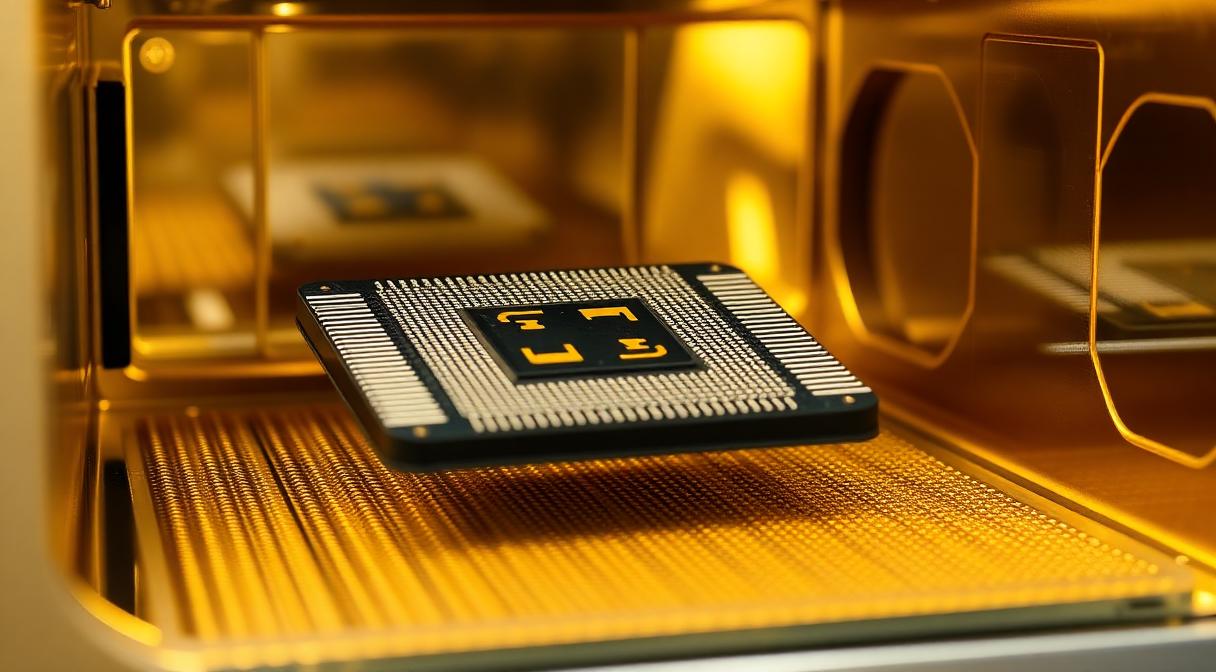
Every qubit architecture is a different bet on how to beat noise. Image generated for editorial use.
The basics: why the count isn't the story
Headlines love a big number: "company unveils 1,000-qubit chip." But qubit count alone is close to meaningless without the other qualities. A thousand noisy, poorly connected qubits can be less useful than a hundred high-fidelity, well-connected ones. When you see a qubit-count headline, the real questions are: how good are those qubits, how well are they connected, and how many useful operations can they perform before errors take over? (More on that in Article 4.)
Going deeper: why no one has won
For readers who want the deeper picture, the hardware race is genuinely undecided, and that's not a failure — it's the rational state of an immature field.
The trade-offs don't collapse into one winner. Superconducting leads on speed and manufacturing maturity; trapped ions lead on fidelity and connectivity; photonics leads on coherence and networking; neutral atoms on flexible scaling; topological on (hoped-for) built-in protection. No single approach dominates on every axis, and the axis that matters most depends on which problems you're ultimately trying to solve. It's entirely possible that different technologies win for different uses.
Cryogenics and engineering are real constraints. Several leading approaches require refrigeration to within a fraction of a degree of absolute zero — colder than deep space — which makes the machines large, power-hungry, and expensive. The challenge of quantum computing is increasingly described as shifting from a physics problem to an engineering problem: the principles are understood, but building reliable, large-scale, manufacturable systems is enormously hard. That framing is optimistic, and not everyone agrees the remaining problems are "merely" engineering.
Connectivity and modularity matter as much as raw count. Whether qubits can talk to one another easily, and whether separate quantum modules can be networked into a larger machine, may determine scalability more than how many qubits fit on a single chip. Several roadmaps now bet on linking modules rather than building one giant processor.
Diversity is a hedge. Because it's unclear which approach will scale to useful, error-corrected machines, the spread of serious bets across technologies is a sensible response to deep uncertainty — not evidence that the field is confused. An investor or observer should be wary of anyone claiming the winning technology is already obvious.
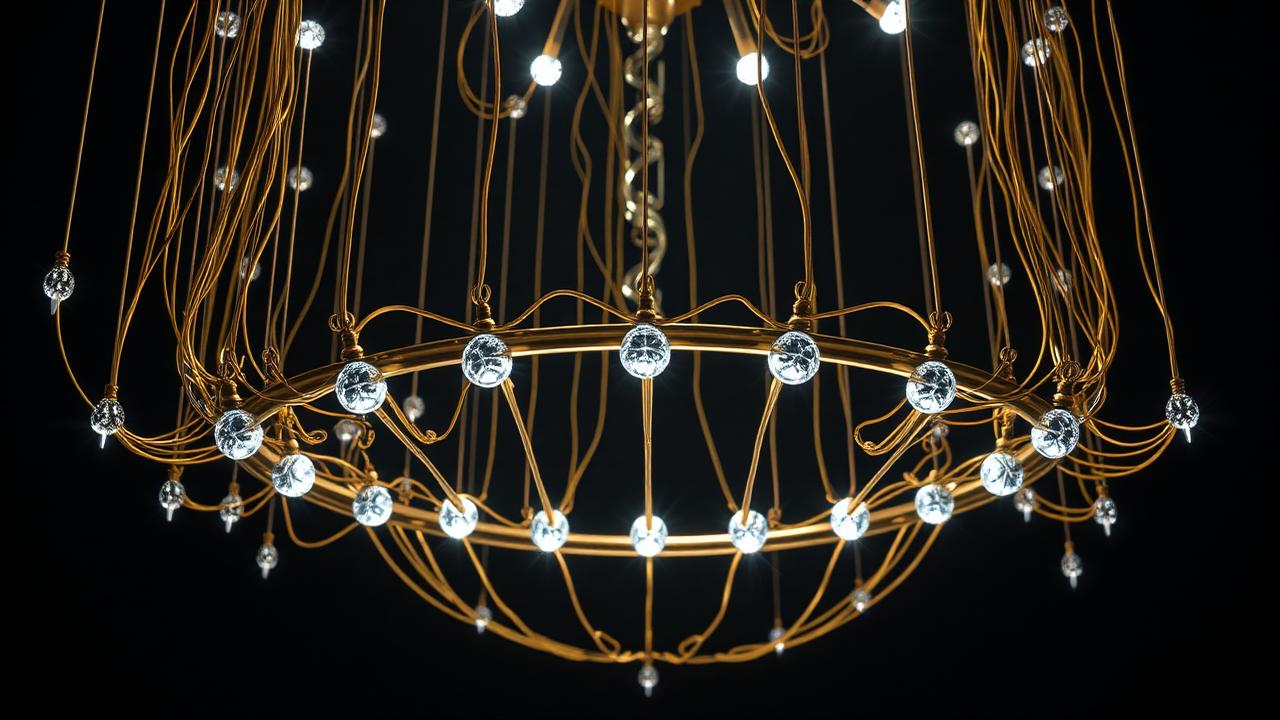
The distinctive 'chandelier' wiring of a superconducting quantum processor. Image generated for editorial use.
The takeaway
Building a qubit means balancing isolation against control, and several physical approaches strike that balance differently: superconducting (fast, mature, needs deep cold), trapped ions (high fidelity, well connected, slower), photonic (great coherence, hard to make photons interact), neutral atoms (flexible, scalable, newer), and topological (potentially self-protecting, least proven). No approach has clearly won, the diversity is a rational hedge, and qubit count alone tells you little without fidelity, connectivity, and usable circuit depth.
What people commonly get wrong
"More qubits means a better computer." Quality, connectivity, and error rates matter at least as much as count.
"One technology has obviously won." The race is genuinely undecided, and may stay multi-winner.
"A qubit-count headline measures progress." Without fidelity and connectivity, the number is nearly meaningless.
"It's basically a solved engineering job now." The "physics-to-engineering" framing is real but contested; hard problems remain.
"Quantum chips work at room temperature." Several leading types need near-absolute-zero cooling.
This article is educational and deliberately simplified. It is not technical, financial, or investment advice; mentions of companies are illustrative of approaches, not endorsements.
Sources for further reading: published roadmaps and technical materials from major quantum-hardware groups (including IBM, Google, IonQ, Quantinuum, QuEra, Pasqal, PsiQuantum, and Microsoft), and independent surveys of qubit modalities. Details reflect 2025–2026 reporting and should be refreshed at publish time.
Next in the series: Article 4 — The Real Enemy: noise, decoherence, and error correction — the obstacle that defines where the field actually stands.
Risk Warning: Trading and investing carries significant risk. Your investments can fall as well as rise. CFDs carry high risk of rapid loss due to leverage. Cryptocurrency is not ASIC-regulated and not covered by AFCA. This is information only, not financial advice. Seek independent advice before investing.
Written by
TradeRadarNews Team
Editorial Team
Our editorial team covers markets, fintech, and regulatory developments across Australia and globally.
Advertisement. Your capital is at risk when trading. Not financial advice.
Risk Warning: Trading and investing carries significant risk. Your investments can fall as well as rise. CFDs carry high risk of rapid loss due to leverage. Cryptocurrency is not ASIC-regulated and not covered by AFCA. This is information only, not financial advice. Seek independent advice before investing.