The Real Enemy: Noise, Decoherence & Error Correction
Why qubits are so fragile, the crucial difference between physical and logical qubits, and how quantum error correction and fault tolerance aim to fix it.
Key Takeaways
1This article covers key developments in the crypto market
2Always verify claims with official ASIC and regulatory sources
3Past performance does not guarantee future results
4Consider speaking to a qualified financial adviser before acting
5TradeRadarNews provides information only — not financial advice
Article 4 of 9 — Foundations of Quantum Computing
If you remember one thing about why we don't already have world-changing quantum computers, make it this: qubits are absurdly fragile, and keeping them stable enough to compute is the hardest problem in the field. Not algorithms, not applications — error. The entire frontier of quantum computing in 2026 is a fight against noise, and the single most important concept for understanding where things really stand is the difference between the qubits a company advertises and the qubits you can actually compute with. This article is about that fight, and that distinction.
The basics explain fragility, error correction, and the physical-versus-logical qubit gap. Going Deeper covers why quantum error correction is so much harder than the classical kind, and the honest debate about how close we are.
The basics: why qubits are so fragile
The quantum properties that make qubits powerful — superposition and entanglement — are also delicate almost beyond belief. The slightest disturbance from the outside world — a stray bit of heat, a vibration, a flicker of electromagnetic field, even cosmic rays — can knock a qubit out of its careful state. This loss of the quantum state is called decoherence, and it happens fast: a qubit might hold its state for only fractions of a second before the environment scrambles it.
On top of decoherence, every operation you perform on a qubit is slightly imperfect, introducing small errors. And because a quantum computation may involve a great many operations, those errors accumulate quickly. Run a circuit too long and the signal you're after drowns in noise. This is the wall the field keeps running into.
The basics: physical vs. logical qubits
Here is the distinction that cuts through most quantum-computing hype.
A physical qubit is an actual piece of hardware — one superconducting circuit, one trapped ion. These are the qubits in the headlines ("a 1,000-qubit chip"). They are noisy and error-prone.
A logical qubit is a single, reliable, error-corrected qubit built out of many physical qubits working together. The idea is to spread one qubit's worth of information across a group of physical qubits with enough redundancy that if some of them err, the overall information survives and the error can be corrected.
The catch is the ratio. With today's error rates, building one good logical qubit can take hundreds or even thousands of physical qubits. So a machine boasting a thousand physical qubits might support only a handful of logical ones — or none yet. When someone cites a giant qubit count, the question that matters is: physical or logical? Almost always, it's physical, and the gap between the two is the gap between today's machines and useful ones.
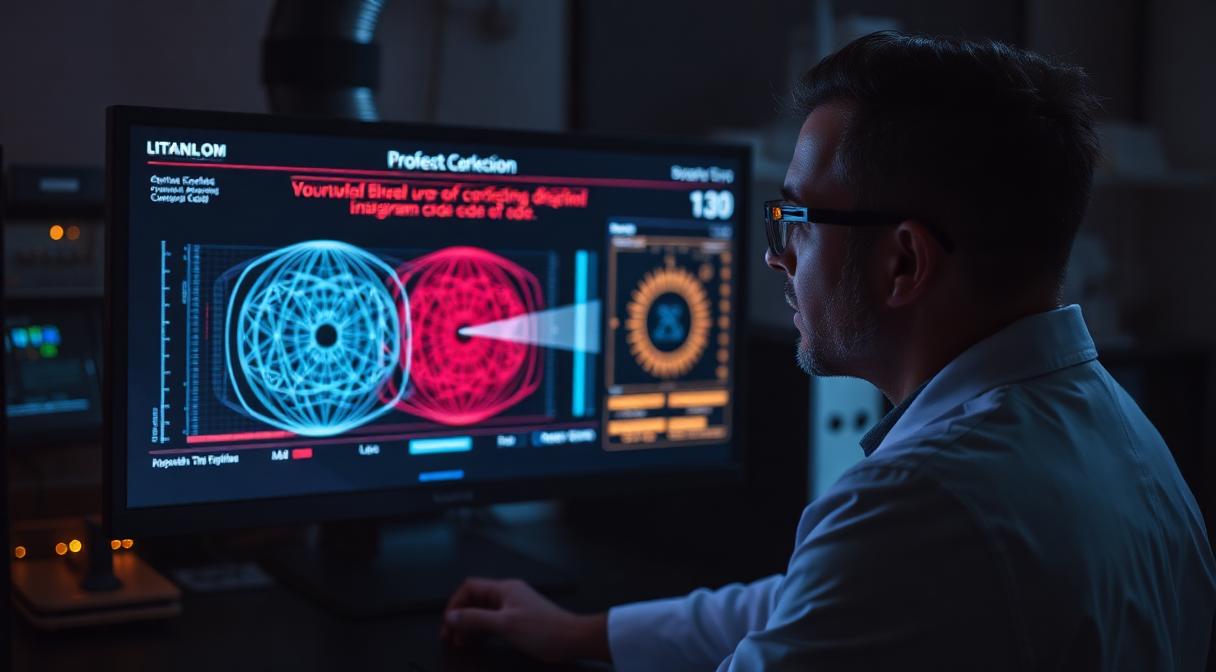
Error correction is the bridge between today's machines and useful ones. Image generated for editorial use.
The basics: quantum error correction and fault tolerance
Quantum error correction (QEC) is the set of techniques for detecting and fixing errors using that redundancy — without directly measuring the data (which would destroy it). Fault tolerance is the goal: a machine that can run long computations reliably even though its individual parts keep making mistakes, because errors are caught and corrected faster than they accumulate.
A key milestone is the threshold, sometimes phrased as going "below threshold": the point at which adding more physical qubits to a logical qubit actually reduces its error rate rather than adding more noise than it removes. Below threshold, scaling up makes things better; above it, scaling up makes things worse. Crossing below threshold is the precondition for everything else.
The basics: where 2026 stands
Real progress has happened. In late 2024, Google's Willow chip demonstrated below-threshold error correction — showing that errors fell as the system grew, a genuine landmark. Through 2025, error-correction results arrived from many groups at once, and IBM has laid out a roadmap toward a fault-tolerant machine (called Starling) around the end of the decade.
But the honest framing matters: these are early steps. Logical error rates remain far above what useful algorithms need, many demonstrations involve preserving a qubit in memory rather than running full computations, and the qubit counts required for genuinely useful fault-tolerant machines are vastly larger than anything built today. The direction is encouraging; the distance remaining is large.
The distinctive 'chandelier' wiring of a superconducting quantum processor. Image generated for editorial use.
Going deeper: why quantum error correction is uniquely hard
For readers who want the deeper reason, quantum error correction can't just copy the classical playbook.
You can't copy, and you can't look. Classical error correction is easy in principle: store three copies of each bit and take a majority vote. Quantum mechanics forbids both moves — the no-cloning theorem (Article 2) means you can't copy an unknown qubit, and measuring a qubit to check it destroys its superposition. QEC is the ingenious workaround: it encodes information across many entangled qubits and measures only carefully chosen combinations that reveal whether an error occurred without revealing — and thus collapsing — the protected data itself. This is far subtler than classical backup, which is why it took decades to develop and is only now being demonstrated at small scale.
The overhead is the crux. Because so many physical qubits are needed per logical qubit, useful fault-tolerant machines may require hundreds of thousands or millions of physical qubits — orders of magnitude beyond today's devices. Shrinking that overhead, through better physical qubits and more efficient codes, is one of the most important research thrusts in the field. Recent advances in more efficient codes are part of why optimism has grown.
The honest debate. Some respected researchers argue the field has reached "escape velocity" — that building a large, useful quantum computer is now an engineering challenge rather than an open physics question. Others caution that the remaining gap is enormous and that scaling error correction to useful sizes may surface problems not yet visible at small scale. Both views are held by serious people. An honest reader holds the tension rather than adopting either the breathless or the dismissive version. Real progress and a long road ahead are both true at once.
The takeaway
Qubits are extraordinarily fragile — decoherence and operational errors corrupt them fast — so the central challenge of quantum computing is error, not algorithms. The crucial distinction is physical qubits (noisy hardware, the headline numbers) versus logical qubits (reliable, error-corrected, built from many physical qubits). Quantum error correction and fault tolerance aim to bridge that gap, and 2024–2026 brought real milestones like below-threshold demonstrations — but logical error rates, demonstration scope, and the sheer physical-qubit overhead mean useful machines remain a substantial distance away.
What people commonly get wrong
Conflating physical and logical qubits. Headline counts are almost always physical; useful logical qubits are far fewer and far harder.
Reading "below threshold" as "solved." It's a vital precondition, not the finish line; error rates are still far from what algorithms need.
Underestimating the overhead. Useful machines may need hundreds of thousands to millions of physical qubits.
Assuming QEC works like classical backup. No-cloning and measurement collapse make it fundamentally subtler.
Picking a side on the timeline. Genuine progress and a long remaining road are both real; serious experts disagree.
This article is educational and deliberately simplified. It is not technical or professional advice. Figures and milestones reflect 2024–2026 reporting and should be refreshed at publish time.
Sources for further reading: Google and IBM publications on quantum error correction and fault-tolerance roadmaps; reporting in Nature and technology press on 2024–2025 error-correction milestones; Nielsen & Chuang for foundational theory.
Next in the series: Article 5 — What Quantum Algorithms Actually Do: where the speed-ups are real, where they're modest, and where they vanish entirely.
Risk Warning: Trading and investing carries significant risk. Your investments can fall as well as rise. CFDs carry high risk of rapid loss due to leverage. Cryptocurrency is not ASIC-regulated and not covered by AFCA. This is information only, not financial advice. Seek independent advice before investing.
Written by
TradeRadarNews Team
Editorial Team
Our editorial team covers markets, fintech, and regulatory developments across Australia and globally.
Advertisement. Your capital is at risk when trading. Not financial advice.
Risk Warning: Trading and investing carries significant risk. Your investments can fall as well as rise. CFDs carry high risk of rapid loss due to leverage. Cryptocurrency is not ASIC-regulated and not covered by AFCA. This is information only, not financial advice. Seek independent advice before investing.