Silver confuses people because it's two things at once. Part of it behaves like gold — a monetary metal people hold to protect wealth. The other part behaves like copper or any industrial input — a raw material...
Key Takeaways
1This article covers key developments in the crypto market
2Always verify claims with official ASIC and regulatory sources
3Past performance does not guarantee future results
4Consider speaking to a qualified financial adviser before acting
5TradeRadarNews provides information only — not financial advice
Silver confuses people because it's two things at once. Part of it behaves like gold — a monetary metal people hold to protect wealth. The other part behaves like copper or any industrial input — a raw material bought by factories because it's the best at a particular job. These two identities pull in different directions, and the tension between them is exactly what makes silver more volatile, more interesting, and harder to read than its more famous cousin.
This article unpacks that split, the supply quirk that makes silver behave unlike almost any other commodity, and the famous ratio investors use to compare it with gold. Beginners can read straight through; if you already know your gold/silver ratio, skip to Going Deeper.
The basics: two jobs in one metal
Roughly half of silver demand is industrial, and that share has been rising. Silver conducts electricity and heat better than any other metal, which makes it close to irreplaceable in a range of technologies:
Solar panels — silver paste is a key component of photovoltaic cells, and the global build-out of solar is a major, growing source of demand.
Electronics — phones, computers, and countless devices use small amounts.
Electric vehicles — modern cars, especially EVs, contain more silver than older models.
AI data centres — the electronics build-out behind artificial intelligence adds to the pile.
The other roughly half is investment and monetary demand: coins, bars, and funds held for the same reasons people hold gold — as a hedge against inflation, currency weakness, and uncertainty.
This dual nature is the single most important thing to understand about silver. When the economy is strong, industrial demand supports it. When fear dominates, monetary demand supports it. But the two don't always line up, and that's where the volatility comes from.
The basics: the supply quirk
Here's the fact that surprises almost everyone. Most silver isn't mined on purpose.
The majority of the world's silver comes out of the ground as a by-product — a secondary output of mines whose main target is copper, lead, or zinc. Only a minority comes from mines built primarily for silver. This has a strange consequence: when the silver price rises, silver supply doesn't necessarily rise to meet it, because most producers are making their decisions based on copper or zinc prices, not silver. Supply is, in the jargon, price-inelastic — slow and reluctant to respond.
Partly as a result, the silver market has run a supply deficit — using more than is newly mined — for several consecutive years, according to the Silver Institute, with the gap filled by drawing down above-ground stocks. A market that consumes more than it produces, year after year, with supply that can't easily respond, is a market with structural tension built in.
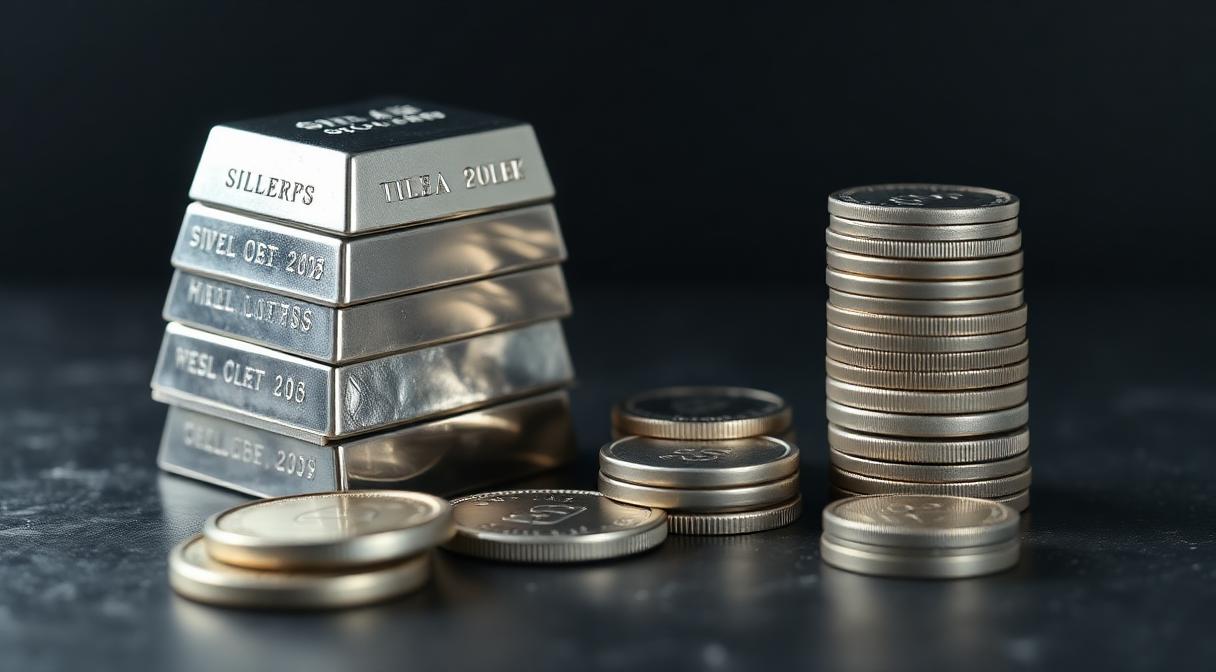
Silver trades as both a monetary metal and an industrial input. Image generated for editorial use.
The basics: the gold/silver ratio
Investors track one number constantly: the gold/silver ratio — how many ounces of silver it takes to buy one ounce of gold. If gold is $4,800 and silver is $80, the ratio is 60.
A high ratio is often read as "silver is cheap relative to gold"; a low ratio as "silver is expensive relative to gold." Through parts of 2026 the ratio sat in the low 60s on a monthly-close basis. Some investors use it as a rough relative-value gauge — but, as the next section warns, it's a thermometer, not a clock.
Going deeper: why silver swings harder
For experienced readers, silver's behaviour follows logically from its structure.
It is a smaller, thinner market than gold. Less money moving in or out produces bigger price moves — which is why silver is sometimes called "gold on steroids." In rallies it often outruns gold; in selloffs it falls further. That asymmetry is structural, not anecdotal.
The by-product supply dynamic deserves emphasis because it breaks the normal commodity feedback loop. Usually, high prices summon new supply, which caps prices. In silver, the supply response is muted because the people digging up most of it care about other metals. A persistent deficit can therefore last far longer than a textbook would predict — though "can last" is not "must continue," and above-ground stocks and recycling provide a release valve.
On the ratio: it's a useful framing for relative value, but it mean-reverts over long, irregular periods and gives no reliable signal about when anything will happen. A "cheap" ratio can get cheaper and stay there for years. Treating it as a timing tool is a classic error. It tells you something about value, almost nothing about timing.
The 2026 backdrop has tightened the story. The silver sector saw notable consolidation — including Pan American Silver's roughly $2.1 billion takeover of MAG Silver and Coeur Mining's earlier acquisition of SilverCrest Metals — and some analysts published base-case 2026 forecasts in the $60–$80 range, with higher scenarios contingent on industrial demand accelerating. Forecasts are not facts; the relevant point is that the bull case rests on the structural supply/demand picture, not on a price chart.
Physical bullion underpins precious-metals exposure for long-term investors. Image generated for editorial use.
The takeaway
Silver is half monetary hedge and half industrial input, and those halves don't always agree. Most of it is mined as a by-product of other metals, so its supply can't respond quickly to price — a recipe for persistent deficits and big swings. The gold/silver ratio is a handy value gauge and a useless stopwatch. Expect more volatility than gold in both directions.
What people commonly get wrong
Assuming silver tracks gold one-for-one. It's correlated but more volatile, with a large industrial component gold doesn't have.
Using the gold/silver ratio to time trades. It signals relative value over long horizons, not turning points.
Underestimating the volatility. A position that feels fine in gold can be twice as turbulent in silver.
Expecting high prices to quickly boost supply. By-product economics mean supply is slow to respond — a key reason deficits persist.
This article is educational and is not investment advice. Silver is more volatile than gold and can lose value rapidly. Price forecasts cited are third-party opinions, not predictions of fact. Verify data against primary sources such as the Silver Institute, and consider speaking with a regulated, independent financial adviser.
Sources for figures cited: The Silver Institute, World Silver Survey 2026; company announcements (Pan American Silver / MAG Silver; Coeur Mining / SilverCrest); independent commodity research as reported in financial press, 2026.
Next in the series: Article 4 — Platinum and Palladium: the industrial precious metals, the cars that need them, and the hydrogen future that might.
Risk Warning: Trading and investing carries significant risk. Your investments can fall as well as rise. CFDs carry high risk of rapid loss due to leverage. Cryptocurrency is not ASIC-regulated and not covered by AFCA. This is information only, not financial advice. Seek independent advice before investing.
Written by
TradeRadarNews Team
Editorial Team
Our editorial team covers markets, fintech, and regulatory developments across Australia and globally.
Advertisement. Your capital is at risk when trading. Not financial advice.
Risk Warning: Trading and investing carries significant risk. Your investments can fall as well as rise. CFDs carry high risk of rapid loss due to leverage. Cryptocurrency is not ASIC-regulated and not covered by AFCA. This is information only, not financial advice. Seek independent advice before investing.