When gold touched a record of roughly $5,589 an ounce in late January 2026 and then slid back toward $4,700 by mid-May, a lot of people heard the headlines without ever quite knowing what they were looking at. Is...
From metal to portfolio
The path runs from the rock to the vehicle you hold. Click any layer to read its piece.
Eight chapters covering the metals, the miners, the vehicles, and the traps to avoid.
Key Takeaways
1This article covers key developments in the crypto market
2Always verify claims with official ASIC and regulatory sources
3Past performance does not guarantee future results
4Consider speaking to a qualified financial adviser before acting
5TradeRadarNews provides information only — not financial advice
When gold touched a record of roughly $5,589 an ounce in late January 2026 and then slid back toward $4,700 by mid-May, a lot of people heard the headlines without ever quite knowing what they were looking at. Is "precious metals" the same thing as "mining"? Is buying a gold coin the same kind of decision as buying shares in a company that digs it up? They are related, but they are not the same — and understanding the difference is the foundation for everything else in this series.
This first article maps the territory: the metals themselves, the two very different jobs they do, and the chain of businesses that turns rock in the ground into something you can hold or own. No prior knowledge assumed. If you already know your bullion from your royalty streams, skip to Going Deeper for the nuance.
The basics: four metals, two jobs
The "precious metals" group most people mean in an investing context is small:
Gold — the classic store-of-value metal.
Silver — part money, part industrial raw material.
Platinum and palladium — together called the platinum group metals, or PGMs, used heavily in industry.
What makes them "precious" is a mix of scarcity, durability, and the fact that they don't corrode or break down. But the more useful way to think about them is by the job each metal is doing at any given moment, because every precious metal does two jobs at once and the balance differs for each.
The first job is monetary — acting as a store of value. This is the role gold is famous for: something people and institutions hold to preserve wealth, especially when they're worried about inflation, currency weakness, or instability. It pays no interest and produces nothing; its value rests on the shared belief that it will still be worth something later.
The second job is industrial — being consumed as a raw material in manufacturing. Silver conducts electricity better than any other metal and goes into solar panels, electronics, and electric vehicles. Platinum and palladium scrub emissions in catalytic converters and feature in hydrogen technology. When a metal is used industrially, its price responds to factory demand and the economic cycle, not just to fear and faith.
Gold sits almost entirely at the monetary end. The PGMs sit almost entirely at the industrial end. Silver lives in the middle — which, as later articles will show, makes it the most interesting and the most volatile of the group.
The basics: "precious metals" vs. "mining"
Here's the distinction that trips up newcomers. Precious metals refers to the physical material — the metal itself. Mining refers to the industry that finds, extracts, processes, and sells it.
You can get involved with one without the other. You can own the metal (a gold coin, a silver bar, a fund that holds bullion in a vault) without owning any piece of a mining business. Or you can own shares in mining companies — businesses with employees, debt, costs, and profits — without ever holding an ounce of metal yourself. These behave differently, carry different risks, and can move in opposite directions on the same day. Article 7 in this series is devoted entirely to those trade-offs; for now, just hold onto the fact that "investing in gold" can mean several very different things.
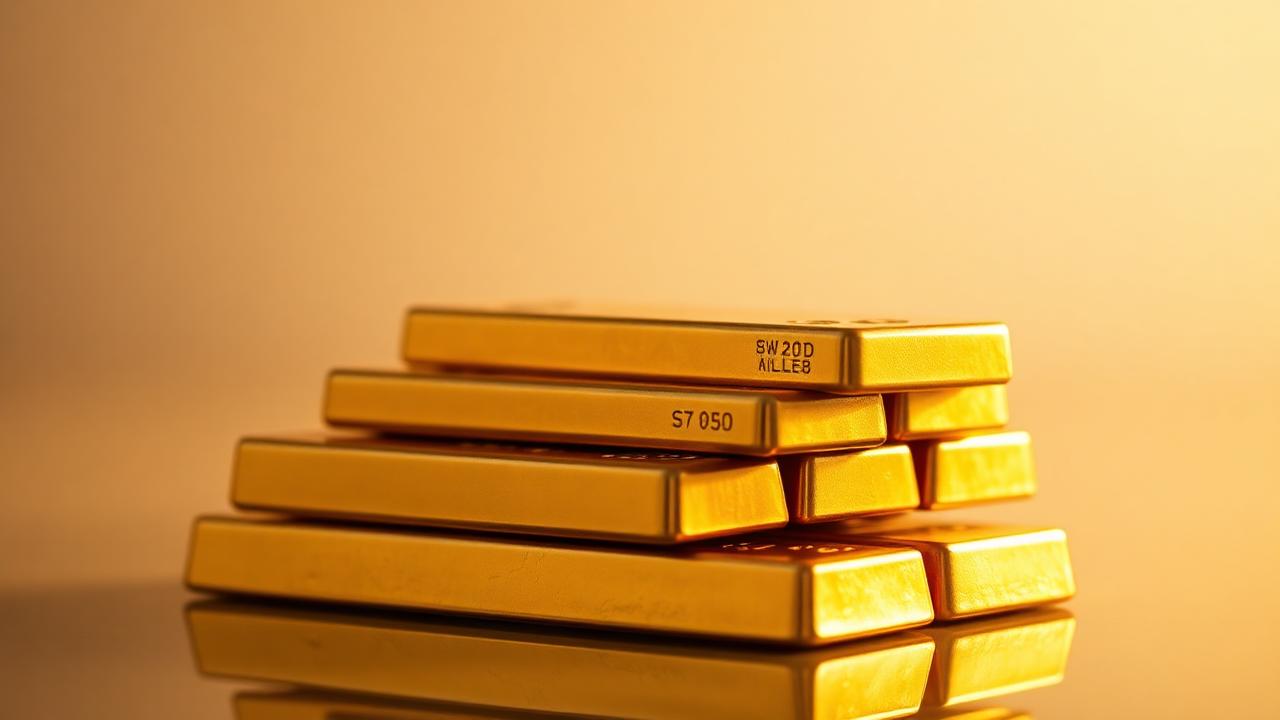
Physical bullion underpins precious-metals exposure for long-term investors. Image generated for editorial use.
The basics: the value chain
The mining side of the sector is best understood as a chain, from earliest and riskiest to latest and steadiest:
Explorers (often called "juniors") — small companies searching for deposits. Most never find anything economic. High risk, no production, often no revenue.
Developers — companies that have found a deposit and are building the mine. Capital-hungry and not yet earning.
Producers (often "majors" or "seniors" when large) — companies actually mining and selling metal. They have real revenue, real costs, and real profits or losses.
Streaming and royalty companies — a financing model rather than a digging model. A royalty is the right to a small percentage of a mine's revenue; a stream is the right to buy some of its metal at a fixed low price. These firms fund miners in exchange for those rights, so they get exposure to metal prices without operating mines themselves.
Refiners — companies that purify the raw output into market-standard bars and grain.
Funds and ETFs — investment vehicles that either hold physical metal or hold baskets of mining shares, letting ordinary investors get exposure without buying coins or picking individual companies.
A quick term you'll meet constantly: reserves vs. resources. A resource is metal a company believes is in the ground. A reserve is the portion it has proven it can extract profitably at current prices. The gap between the two is where a lot of optimism — and a lot of disappointment — lives. Article 5 unpacks this properly.
Going deeper: why the structure matters
For more experienced readers, the value chain isn't just taxonomy — it's a map of where risk and leverage sit.
Mining equities are, in effect, a leveraged play on the metal price. Because a miner's costs are relatively fixed, a modest rise in the metal price can translate into a much larger rise in profit, and the reverse on the way down. 2025 illustrated this vividly: industry commentary noted gold rising roughly 65% on the year while gold mining equities rose far more steeply. That leverage cuts both ways, and it's the single biggest reason mining shares and physical metal are not interchangeable.
Streaming and royalty companies exist precisely to soften the operational risk of mining. They carry no labour disputes, no diesel bills, no flooded shafts — just contractual exposure to output and price. That structural cushion is why they tend to behave more steadily than the miners they finance, and why they're worth understanding as their own category rather than lumping them with producers.
The sector is also unusually cyclical and consolidation-prone. Strong free cash flow at large producers in 2025–2026 fuelled a visible wave of mergers and acquisitions — Pan American Silver's roughly $2.1 billion takeover of MAG Silver and Coeur Mining's acquisition of SilverCrest among them. M&A waves change the investable universe: today's promising junior may be tomorrow's acquired asset, and that possibility is part of how the sector prices smaller companies.
Finally, supply behaves in counterintuitive ways. A large share of the world's silver is produced as a by-product of copper, lead, and zinc mining. That means silver supply doesn't necessarily rise when silver prices rise — it's tethered to demand for entirely different metals. The World Bank's April 2026 Commodity Markets Outlook projecting precious metals as the year's top-performing commodity class only sharpens why these supply mechanics are worth knowing rather than assuming.
The takeaway
Precious metals are the material; mining is the industry around it. Each metal does a monetary job and an industrial job in different proportions, which is why they don't all move together. And "getting exposure" can mean holding metal, owning operating companies, owning the financiers of those companies, or owning a fund — each with a distinct risk profile. Everything else in this series builds on those three ideas.
What people commonly get wrong
Treating "gold" and "gold miners" as the same trade. They're correlated but not identical, and miners can fall while metal rises (or vice versa) on company-specific news.
Assuming all four metals move together. Gold can climb on fear while palladium falls on weak car production — they answer to different masters.
Reading a record price as a buy signal. Gold's early-2026 peak-then-pullback is a reminder that prices move in both directions and that headlines lag reality.
Confusing resources with reserves. Metal "in the ground" is not the same as metal a company can profitably extract.
Chasing the loudest story. This is a sector that attracts heavy promotion. The quality of the source matters more than the confidence of the claim — a theme we return to in Article 9.
This article is educational and is not investment advice. It does not recommend buying or selling any metal, security, or product. Precious metals and mining investments can be volatile and can lose value. Always verify figures against primary sources and consider speaking with a regulated, independent financial adviser before making decisions.
Sources for figures cited: World Bank, Commodity Markets Outlook (April 2026); World Gold Council; The Silver Institute, World Silver Survey 2026; company announcements (Pan American Silver / MAG Silver; Coeur Mining / SilverCrest). Spot price levels as reported in mainstream financial press, early–mid 2026.
Next in the series: Article 2 — Gold, Explained: why a metal that pays no interest holds its value, and what actually drives its price.
Risk Warning: Trading and investing carries significant risk. Your investments can fall as well as rise. CFDs carry high risk of rapid loss due to leverage. Cryptocurrency is not ASIC-regulated and not covered by AFCA. This is information only, not financial advice. Seek independent advice before investing.
Written by
TradeRadarNews Team
Editorial Team
Our editorial team covers markets, fintech, and regulatory developments across Australia and globally.
Advertisement. Your capital is at risk when trading. Not financial advice.
Risk Warning: Trading and investing carries significant risk. Your investments can fall as well as rise. CFDs carry high risk of rapid loss due to leverage. Cryptocurrency is not ASIC-regulated and not covered by AFCA. This is information only, not financial advice. Seek independent advice before investing.