The Energy Mix Explained: What Actually Powers the World
A beginner's guide to the energy mix: oil, gas, coal, nuclear, and renewables, plus the key difference between baseload, intermittent, and dispatchable power.
Key Takeaways
1This article covers key developments in the crypto market
2Always verify claims with official FCA and regulatory sources
3Past performance does not guarantee future results
4Consider speaking to a qualified financial adviser before acting
5TradeRadarNews provides information only — not financial advice
Article 2 of 9 — Foundations of the Energy & Defense Sectors
Ask where electricity comes from and you'll get a different answer depending on who you ask and what they want to sell you. The honest answer in 2026 is: all of it at once. Oil, gas, coal, nuclear, water, sun, and wind each carry part of the load, and the mix shifts by country, by season, and even by time of day. Before you can follow any argument about the "energy transition" or "energy security," you need a clear picture of what each source actually does — and, crucially, the difference between power that's always there and power that comes and goes.
This article lays out the mix in plain terms. Beginners can read straight through; the Going Deeper section covers the single most misunderstood idea in energy — capacity versus generation.
The basics: primary energy vs. electricity
First, a distinction that prevents endless confusion. Primary energy is all the energy a society uses, including fuel burned directly for transport, heating, and industry. Electricity is just one slice of that — the power flowing through the grid. Cars running on petrol and furnaces burning gas use energy without it ever being electricity. So "the world is electrifying" and "the world still runs largely on fossil fuels" can both be true at once: electricity is getting cleaner faster than total energy use is.
Keep that split in mind, because debates often blur them.
The basics: the sources
Fossil fuels — oil, natural gas, and coal. Burned for energy, they're the historical backbone and still dominate total primary energy. Oil mainly powers transport; gas does power generation, heating, and industry; coal is mostly power generation and is in long-term decline in many regions.
Nuclear — splitting uranium atoms releases heat that makes steam to drive turbines. It produces large amounts of steady, near-zero-carbon electricity (more in Article 4).
Renewables — energy from natural flows that don't deplete:
Solar — photovoltaic panels turning sunlight into electricity.
Wind — turbines, onshore and offshore.
Hydro — power from flowing or falling water; the oldest large-scale renewable.
Geothermal — heat from underground.
Storage — not a source but an enabler: batteries and pumped-hydro store energy for when it's needed (Article 5).
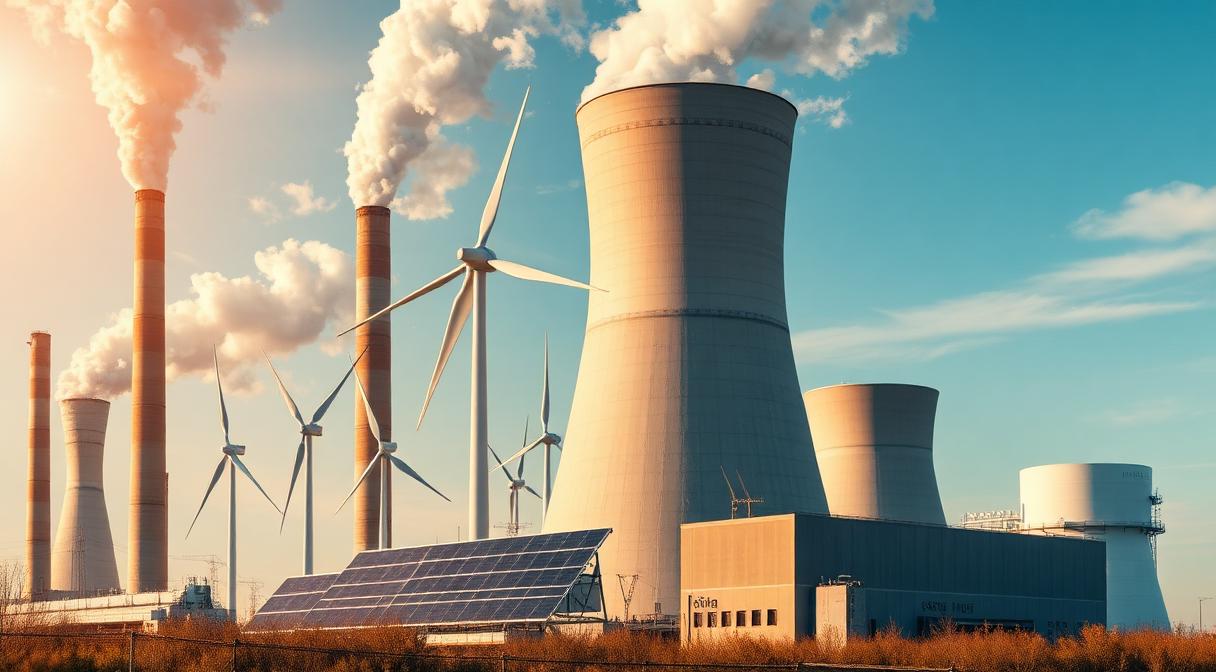
The global energy mix is shifting but every leg still matters to investors. Image generated for editorial use.
The basics: baseload, intermittent, dispatchable
This is the vocabulary that makes the whole sector legible.
Baseload power runs steadily around the clock — traditionally coal and nuclear, and some gas. It covers the constant minimum demand.
Intermittent power depends on conditions you don't control: solar only works when the sun shines, wind only when it blows. The energy is free and clean, but it isn't there on demand.
Dispatchable power can be turned up or down when operators choose — gas "peaker" plants, hydro, and increasingly batteries. Dispatchability is what keeps a grid stable when demand spikes or intermittent sources fade.
The reason the world uses a mix rather than picking a winner is that these qualities don't all live in one source. Renewables are cheap and clean but intermittent; nuclear is steady but slow and costly to build; gas is flexible but emits carbon. Every grid is a balancing act between them.
The basics: where 2026 stands
Two facts capture the moment. First, renewables are now the growth story in capacity: Wood Mackenzie expected global solar and wind capacity to reach about 4,000 GW in 2026, overtaking operating coal- and gas-fired capacity. Second, fossil fuels — especially natural gas — remain essential for reliability, with gas widely re-established as a "transition and backstop" fuel that fills in when renewables can't. And nuclear is enjoying a resurgence (Article 4). The direction of travel is toward clean power; the pace and the reliance on gas in the meantime are exactly what's debated.
Offshore production remains central to global energy supply and listed energy equities. Image generated for editorial use.
Going deeper: capacity is not generation
Here is the idea that separates informed readers from headline-skimmers.
Capacity is the maximum a plant could produce if it ran flat out. Generation is what it actually produces. The ratio between them is the capacity factor, and it varies enormously by source.
A nuclear plant might run at a 90%-plus capacity factor — almost always on. A solar farm's capacity factor might be 15–25%, because the sun is down half the time and weak much of the rest. So "solar and wind capacity has overtaken coal and gas capacity" — a real 2026 milestone — does not mean they generate more electricity. A gigawatt of solar and a gigawatt of nuclear are not equivalent in output. Anyone who quotes capacity figures as if they were generation figures is, knowingly or not, overstating the case.
This is why intermittency matters so much. To replace steady baseload with intermittent sources, you need either far more capacity, a lot of storage, dispatchable backup, or all three — which is the real engineering and economic challenge of the transition, and the subject of Article 5.
A second deeper point: energy density. Fossil fuels and uranium pack enormous energy into little volume, which is why they're hard to displace in uses like aviation, shipping, and heavy industry. Electricity from renewables is making fast progress in power generation but slower progress in those dense-energy corners. The transition is uneven by sector, not a single switch being flipped.
The takeaway
The world runs on a mix because no single source is cheap, clean, steady, and flexible all at once. The key vocabulary is baseload (always on), intermittent (sun and wind, variable), and dispatchable (controllable). And the most important trap is confusing capacity (what could be produced) with generation (what actually is) — renewables lead on capacity growth, but capacity factors mean that's not the same as leading on output. The direction is toward clean power; the contested questions are how fast and how much gas and nuclear bridge the gap.
Defence and aerospace contractors are a core leg of the new industrial-policy trade. Image generated for editorial use.
What people commonly get wrong
Confusing capacity with generation. A gigawatt of solar produces far less over a year than a gigawatt of nuclear; capacity factors differ hugely.
Mixing up primary energy and electricity. Electricity is greening faster than total energy use; both pictures are valid.
Expecting one source to "win." The mix exists because each source has a different weakness.
Ignoring intermittency. Cheap, clean power that isn't available on demand creates a reliability problem that has to be solved separately.
Forgetting energy density. Some sectors (aviation, heavy industry) resist electrification for physical, not political, reasons.
This article is educational and is not investment advice. The pace and shape of the energy transition are genuinely contested; this series presents the debate rather than resolving it. Verify figures against primary sources such as the IEA, EIA, and BloombergNEF, and consider speaking with a regulated, independent financial adviser.
Sources for context: Wood Mackenzie, Five themes shaping the energy world in 2026; International Energy Agency; U.S. EIA Annual Energy Outlook 2026; BloombergNEF New Energy Outlook 2026; PwC 2026 energy outlook. Figures reflect 2026 reporting and should be refreshed at publish time.
Next in the series: Article 3 — Oil & Gas in 2026: how the industry is structured, why gas became the "backstop fuel," and what moves the price.
Risk Warning: Trading and investing carries significant risk. Your investments can fall as well as rise. CFDs carry high risk of rapid loss due to leverage. Cryptocurrency is not FCA-regulated and not covered by FSCS. This is information only, not financial advice. Seek independent advice before investing.
Written by
TradeRadarNews Team
Editorial Team
Our editorial team covers markets, fintech, and regulatory developments across the UK and globally.
Advertisement. Your capital is at risk when trading. Not financial advice.
Risk Warning: Trading and investing carries significant risk. Your investments can fall as well as rise. CFDs carry high risk of rapid loss due to leverage. Cryptocurrency is not FCA-regulated and not covered by FSCS. This is information only, not financial advice. Seek independent advice before investing.