From the energy mix at the top to the risk & ethics chapter at the bottom — eight pieces, one investable story.
Key Takeaways
1This article covers key developments in the crypto market
2Always verify claims with official FCA and regulatory sources
3Past performance does not guarantee future results
4Consider speaking to a qualified financial adviser before acting
5TradeRadarNews provides information only — not financial advice
Article 1 of 9 — Foundations of the Energy & Defense Sectors
At first glance, a wind farm and a fighter jet have nothing to do with each other. One generates electricity; the other is a weapon system. Yet through 2025 and into 2026, governments, investors, and policymakers increasingly discussed energy and defense in the same breath — and not by accident. Both sectors sit on top of the same fault lines: geopolitics, fragile supply chains, scarce critical minerals, and decisions that play out over decades. Understanding why they've converged is the foundation for everything else in this series.
This first article maps the shared territory: what each sector actually is, the themes that bind them, and why "energy security" has come to mean something close to "national security." No prior knowledge assumed. If you already grasp the energy-security frame, skip to Going Deeper for how the two sectors interlock.
The basics: two sectors, briefly
Energy is the business of producing, moving, storing, and selling power — from oil and gas wells to power stations, solar farms, wind turbines, pipelines, electricity grids, and batteries. It spans fuels you burn and electrons you generate, and it touches almost every other part of the economy because almost everything runs on it.
Defense is the industry that designs, builds, and sustains the equipment and services militaries use — aircraft, ships, vehicles, missiles, satellites, electronics, and increasingly cyber and software systems. Its primary customer is government, which makes it unusual: demand is set by budgets and policy, not by ordinary consumers.
On their own, each is enormous. The reason to study them together is that, in 2026, the forces moving them have started to rhyme.
The basics: why "energy security" became "national security"
For decades, energy policy was mostly about cost and reliability — keeping the lights on at a reasonable price. That changed. A run of shocks — pandemic-era supply-chain breakdowns, Russia's full-scale invasion of Ukraine and the resulting scramble to replace Russian gas, trade restrictions on key materials, and conflicts affecting major energy suppliers — taught governments a hard lesson: an economy that depends on energy it can't control is vulnerable in a way that is fundamentally a security problem, not just an economic one.
The International Energy Agency captured the shift plainly in 2026, describing energy as having been elevated to a core issue of national and economic security. Once you see energy that way, it sits naturally alongside defense: both are about a nation's ability to function and protect itself when the world turns hostile. A country that can't keep its power on, or can't equip its military, has the same underlying weakness expressed two ways.
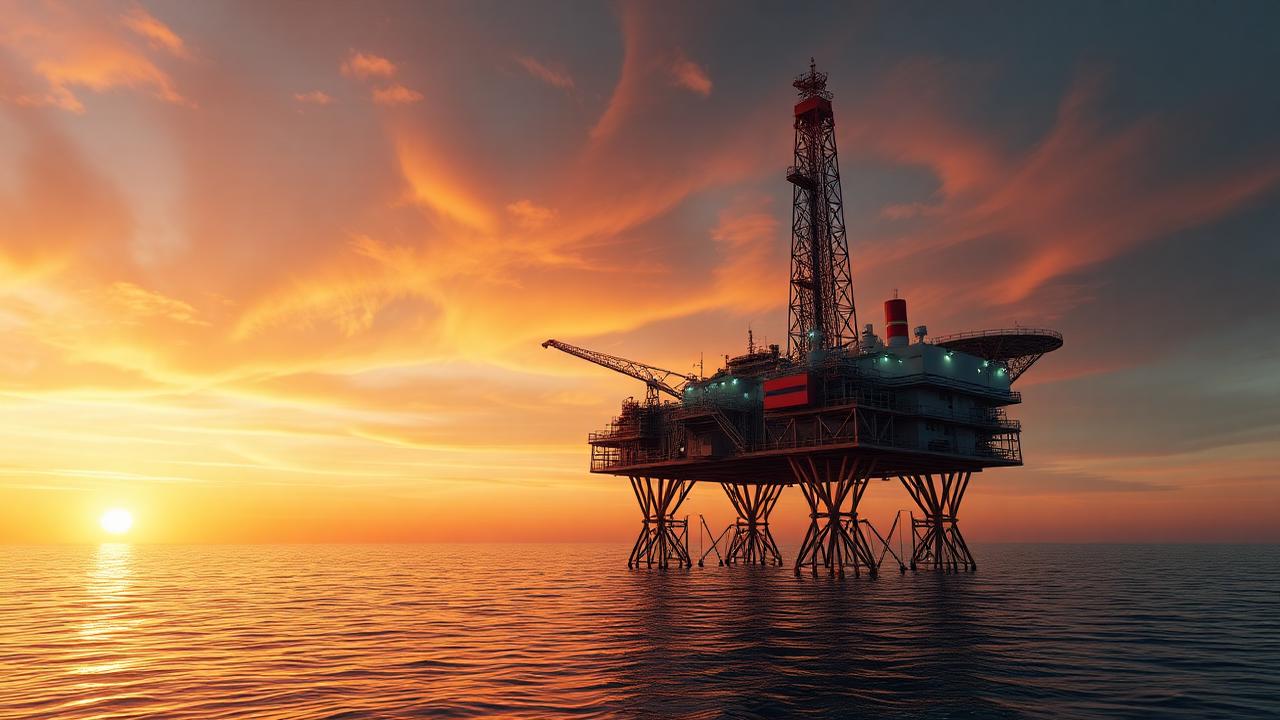
Offshore production remains central to global energy supply and listed energy equities. Image generated for editorial use.
The basics: the themes they share
Four threads run through both sectors, and you'll meet all of them repeatedly in this series.
Geopolitics is a primary driver. Wars, alliances, sanctions, and rivalries move both energy prices and defense budgets directly. When tension rises, defense spending climbs and energy markets lurch — often at the same time, for the same reasons.
Supply chains are strategic, not just logistical. Both sectors have learned that depending on a single country or region for a critical input is a liability. "Resilience" — the ability to keep operating when a supplier is cut off — has become a goal in its own right, sometimes even at the expense of lowest cost.
Critical minerals are a shared chokepoint. The metals and minerals that go into batteries, wind turbines, and solar panels overlap heavily with those needed for advanced defense systems. The same handful of supplier countries dominates both. Article 6 is devoted to this overlap.
Capital cycles are long and policy-dependent. A power station, a mine, or a new combat aircraft takes many years and vast sums to bring online, and government policy can make or break the economics. Both sectors reward patience and punish those who mistake a policy tailwind for a permanent law.
Going deeper: how the two sectors interlock
For readers who want more than the surface frame, the connections are concrete.
Energy security shapes defense posture, and vice versa. Militaries are among the largest single consumers of fuel, and a force that can't be supplied with energy can't operate. Meanwhile, securing energy supply routes — shipping lanes, pipelines, chokepoints like the Strait of Hormuz — is itself a defense mission. The two sectors aren't just analogous; they physically depend on each other.
They compete for the same minerals. The build-out of clean energy and the modernization of militaries draw on overlapping critical-mineral supply chains, and in 2026 the concentration of those supply chains in a few countries was widely flagged as a strategic vulnerability. When clean-energy demand and defense demand pull on the same constrained resource, supply-chain policy becomes a place where energy and defense strategy literally merge.
Government is the dominant force in both. In defense, government is the customer. In energy, government sets the rules — subsidies, tax credits, tariffs, permits, and security mandates — that determine which projects get built. That makes both sectors unusually sensitive to elections and policy reversals, a risk this series returns to in the final article. An investor or analyst who ignores politics in these sectors is missing the main variable.
The investment landscape has been reframed. A notable 2026 development was a reassessment of environmental, social, and governance (ESG) criteria around defense: amid a deteriorating European security environment and rising budgets, many funds that had previously avoided defense reopened to it, and a wave of new defense listings and venture funding followed. This is a genuine shift in how capital views the sector — and it's contested, which is exactly why the ethics article later in this series presents the debate rather than settling it.
The throughline: both sectors are being re-understood through the lens of security and resilience rather than pure cost and efficiency. That reframing — slow, structural, and politically charged — is the single most important idea in this series.
Defence and aerospace contractors are a core leg of the new industrial-policy trade. Image generated for editorial use.
The takeaway
Energy and defense have converged because they now answer to the same forces: geopolitics, strategic supply chains, shared critical-mineral chokepoints, and long, policy-driven capital cycles. The unifying idea is that energy security has become a dimension of national security, which places the two sectors side by side. Government is the decisive actor in both, which makes politics the variable you can least afford to ignore.
What people commonly get wrong
Treating energy and defense as unrelated. They increasingly share drivers, supply chains, and even physical dependencies.
Reading "energy security" as just a slogan. It reflects a real, structural reframing of energy as a security issue, with policy consequences.
Underestimating government. In defense it's the customer; in energy it sets the rules. Politics is the main variable, not background noise.
Mistaking a policy tailwind for a permanent trend. Subsidies, mandates, and budgets can reverse — both sectors are exposed to that.
Assuming the ESG reframing of defense is settled. It's a live, contested shift, not a consensus.
This article is educational and is not investment advice. The energy and defense sectors involve contested policy and ethical questions, which this series aims to present fairly rather than resolve. Verify all figures against primary sources and consider speaking with a regulated, independent financial adviser before making decisions.
Sources for context: International Energy Agency, State of Energy Policy 2026; IISS, The Military Balance 2026; NATO (Hague Summit defence-investment commitments); PwC and industry 2026 outlooks on energy and defense. Figures reflect 2025–2026 reporting and should be refreshed at publish time.
Next in the series: Article 2 — The Energy Mix Explained: oil, gas, coal, nuclear, and renewables — what each actually contributes, and the difference between baseload and intermittent power.
Risk Warning: Trading and investing carries significant risk. Your investments can fall as well as rise. CFDs carry high risk of rapid loss due to leverage. Cryptocurrency is not FCA-regulated and not covered by FSCS. This is information only, not financial advice. Seek independent advice before investing.
Written by
TradeRadarNews Team
Editorial Team
Our editorial team covers markets, fintech, and regulatory developments across the UK and globally.
Advertisement. Your capital is at risk when trading. Not financial advice.
Risk Warning: Trading and investing carries significant risk. Your investments can fall as well as rise. CFDs carry high risk of rapid loss due to leverage. Cryptocurrency is not FCA-regulated and not covered by FSCS. This is information only, not financial advice. Seek independent advice before investing.