The Chips That Run AI: The S&P 500's Three AI Chip Stocks
Nvidia, AMD, and Broadcom are the S&P 500's core AI chip stocks. Here's how GPUs and custom silicon differ — and where the accelerator market is heading.
Key Takeaways
1This article covers key developments in the crypto market
2Always verify claims with official ASIC and regulatory sources
3Past performance does not guarantee future results
4Consider speaking to a qualified financial adviser before acting
5TradeRadarNews provides information only — not financial advice
Three companies — Nvidia, AMD, and Broadcom — build almost all the silicon that trains and runs artificial intelligence. Here is how each attacks the same problem differently, and where the accelerator market is heading.
Every time someone prompts a chatbot, generates an image, or trains a model, the real work — trillions of mathematical operations repeated at enormous scale — happens on a specialized chip called an accelerator. It is the closest thing the AI boom has to a fundamental unit. You can measure an AI build-out in dollars, in megawatts, or in square feet of data center, but the number that ultimately matters is how many of these chips are running and how fast. A handful of companies make them. Three of those sit in the S&P 500, and although they are often lumped together as "AI chip stocks," they are not doing the same thing. They are attacking the same job — do the math, do it fast, do it efficiently — from three different directions.
For decades the general-purpose CPU ran most computing. AI broke that model. Training a large model and then running it ("inference") means performing the same kind of operation — multiplying large grids of numbers — billions of times in parallel. CPUs handle tasks one after another; accelerators are built to do thousands at once. That parallelism is the whole game.
There are two ways to build one. A GPU (graphics processing unit) is general-purpose within the AI world: one chip architecture that can run almost any model, which is what Nvidia and AMD sell. An ASIC — an application-specific integrated circuit, which the industry calls an "XPU" in this context — is custom silicon tuned to one company's specific workloads, which is the business Broadcom enables. The trade-off is flexibility versus efficiency: a GPU runs anything; a custom chip can run one thing better, cheaper, and at lower power.
Two shared dependencies are worth holding onto. First, none of these chips works without high-bandwidth memory stacked alongside it — the memory supply is, in practice, a hard limit on how many accelerators can ship. Second, nearly all of this silicon, whoever designs it, is physically manufactured by a single foundry, TSMC (not an S&P 500 company, but the factory floor for the entire industry).
Nvidia: the incumbent
What it does. Nvidia (NVDA) designs the GPUs that have become the default choice for AI. When a lab or a cloud provider needs compute, Nvidia's chips are the baseline against which everything else is measured.
The numbers. In fiscal 2026 (the year ended January 2026), Nvidia reported record revenue of about $215.9 billion, up 65%, according to its earnings release. Data center is now roughly 90% of the company — in the fiscal fourth quarter, data center revenue alone was $62.3 billion, up 75% year over year, with gross margins around 75%. Networking, a sign that Nvidia increasingly sells whole systems rather than loose chips, grew 263% year over year in that quarter. For the following quarter (fiscal Q2 2027) the company guided to roughly $91 billion in revenue.
The edge. Hardware is only half of it. Nvidia's deeper moat is CUDA, the software layer developers have built on for years; moving a workload off it is costly and slow. That lock-in, plus a head start on each new generation, is why Nvidia has held the dominant share of AI accelerators — estimated at around 70%, and higher by some measures. Multi-gigawatt commitments from the likes of OpenAI and Anthropic point to demand booked well ahead.
The risk. Concentration cuts both ways. More than half of data center revenue comes from a small group of hyperscalers — and those same customers are now designing their own chips specifically to depend on Nvidia less.
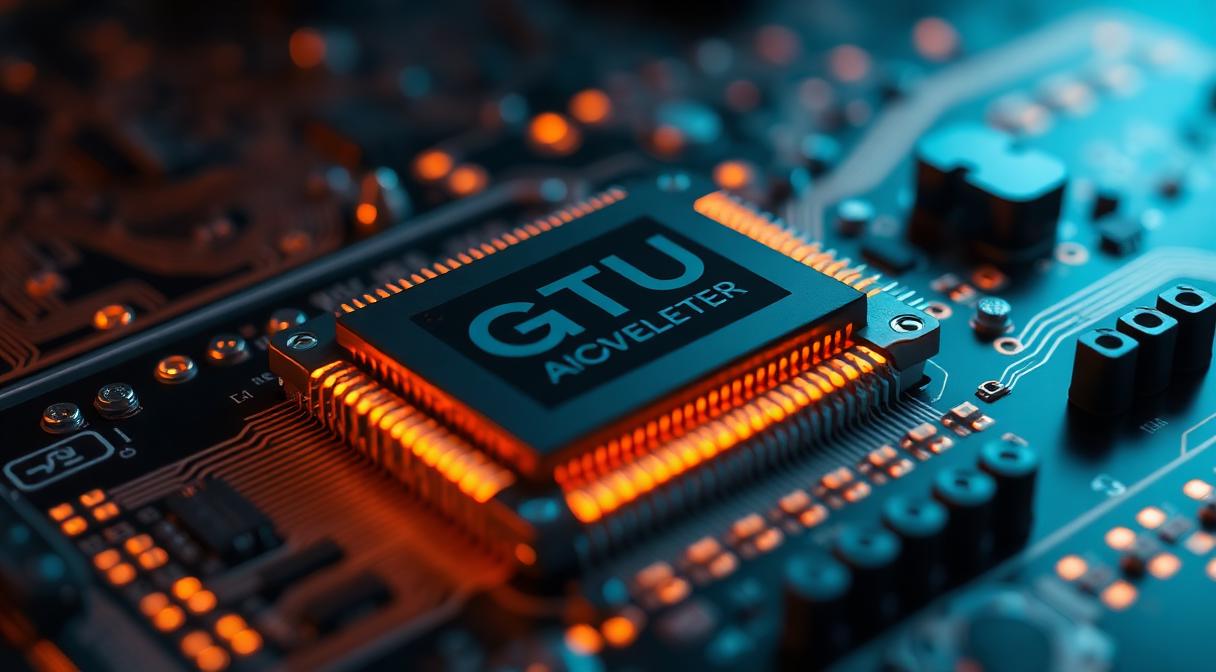
Accelerator silicon sits at the centre of the AI infrastructure trade. Image generated for editorial use.
AMD: the second source
What it does. AMD (AMD) is the credible alternative GPU maker — the company the rest of the market needs to exist so that Nvidia is not the only option.
The numbers. AMD's data center segment generated a record $16.6 billion in 2025, up 32%, and growth accelerated into 2026: data center revenue of $5.8 billion in the first quarter of 2026 (ended March), up 57% year over year, per its results. The figures are a fraction of Nvidia's, but the trajectory is the point.
The edge. Two deals reset AMD's standing. Meta committed to deploy up to six gigawatts of AMD Instinct GPUs, the first gigawatt on a custom MI450-based chip; OpenAI signed a multi-year agreement for six gigawatts, with the first MI450 capacity arriving in the second half of 2026 and the potential, AMD has said, to generate well over $100 billion in revenue over several years. The product backing this is the MI400 series, built on TSMC's 2nm process with 432 GB of next-generation HBM4 memory, and the rack-scale Helios platform shipping in the third quarter of 2026.
The risk. AMD holds only around 10% of the accelerator market and is shipping into a contest where the incumbent owns the software ecosystem. The bull case rests on the market growing fast enough that a strong number two is still a very large business.
Broadcom: the arms dealer
What it does. Broadcom (AVGO) does not sell a branded GPU. It co-designs custom chips — XPUs — so that the biggest technology companies can build their own accelerators and lean less on Nvidia. It is the picks-and-shovels supplier to the companies that are themselves picks-and-shovels suppliers.
The numbers. In fiscal Q1 2026 (ended early February 2026), Broadcom reported record revenue of $19.3 billion, up 29%, with AI revenue of $8.4 billion, up 106% year over year, according to its release. It guided the next quarter to roughly $22 billion in total revenue and $10.7 billion in AI semiconductors.
The edge. Broadcom has six confirmed major XPU customers, with Google the longest-standing — seven generations of co-designed chips since 2014 — and others including Meta, OpenAI, and Anthropic. The company has disclosed a $73 billion AI backlog, including an $11 billion order from Anthropic, and has told investors it sees a path to more than $100 billion in AI chip revenue in 2027.
The risk. Custom AI hardware carries gross margins of roughly 45–55%, well below the 80%-plus on Broadcom's legacy networking products. Growth here comes at a structurally lower margin, a genuine tension as the AI mix grows.
Equity markets price in macro shifts, earnings and policy in real time. Image generated for editorial use.
How the three AI chip stocks compare
The real contest is not Nvidia versus AMD. It is general-purpose GPUs versus purpose-built ASICs — and the evidence says the mix is shifting. Custom ASICs are the faster-growing category: by some industry estimates, ASIC-based AI servers reach close to 28% of the market in 2026, with custom-chip shipments growing far quicker than merchant GPUs.
The bull case for GPUs is flexibility and software. Models change constantly; a GPU runs whatever comes next, and CUDA keeps developers in place. The bull case for ASICs is economics: if you know exactly the workload you will run at vast scale — as the hyperscalers do — a chip tuned for it is cheaper to run and easier to power. Both can be true at once, which is why the most likely outcome is not one winner but a market large enough for several. Sizing it: Bloomberg Intelligence projects the AI accelerator market growing at roughly 16% a year to more than $600 billion by 2033, from about $116 billion in 2024.
One caveat sits underneath all three. Whatever the design, nearly every leading-edge AI chip is fabricated by TSMC. That single point of concentration is a risk the whole layer shares.
This article is for information only and is not investment advice or a recommendation to buy or sell any security. TradeRadarNews is not a licensed financial adviser. Figures are accurate as of June 2026 and will change. Do your own research.
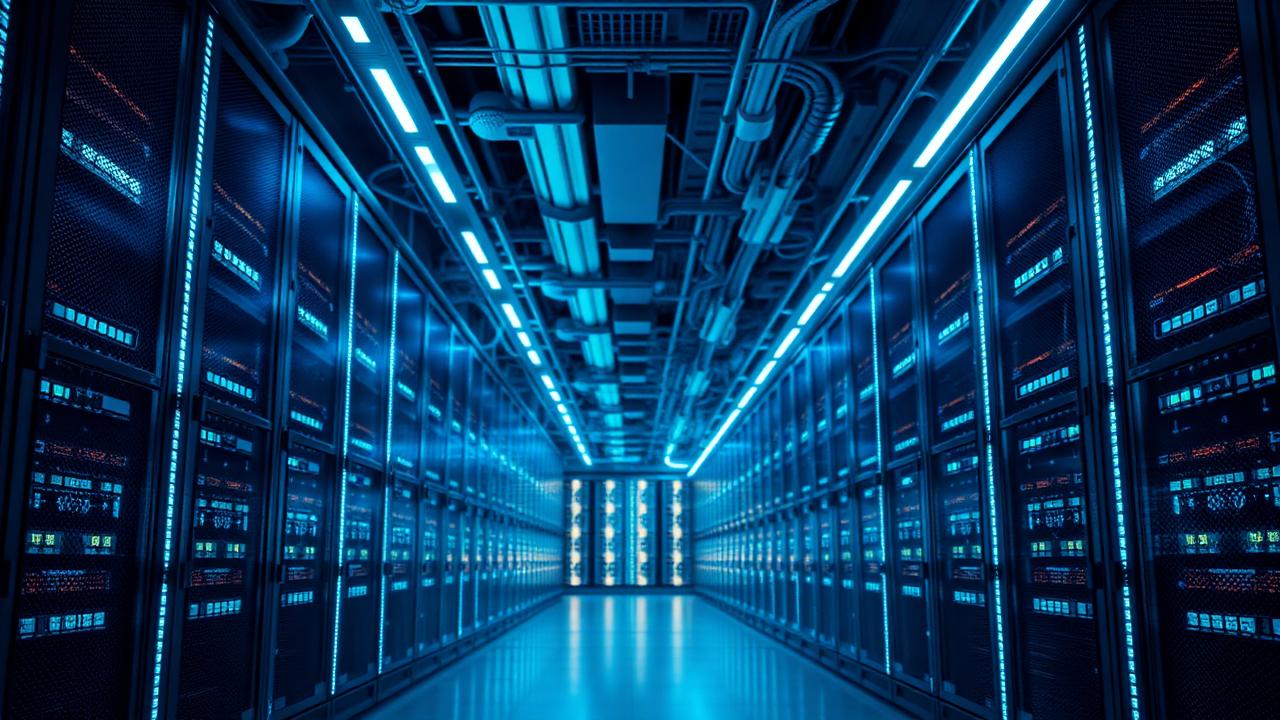
AI data centres now anchor a multi-trillion dollar infrastructure build-out. Image generated for editorial use.
Risk Warning: Trading and investing carries significant risk. Your investments can fall as well as rise. CFDs carry high risk of rapid loss due to leverage. Cryptocurrency is not ASIC-regulated and not covered by AFCA. This is information only, not financial advice. Seek independent advice before investing.
Written by
TradeRadarNews Team
Editorial Team
Our editorial team covers markets, fintech, and regulatory developments across Australia and globally.
Advertisement. Your capital is at risk when trading. Not financial advice.
Risk Warning: Trading and investing carries significant risk. Your investments can fall as well as rise. CFDs carry high risk of rapid loss due to leverage. Cryptocurrency is not ASIC-regulated and not covered by AFCA. This is information only, not financial advice. Seek independent advice before investing.