HBM is the tightest bottleneck in AI. Meet the HBM memory stocks — Micron, plus storage names Seagate and Western Digital — riding a memory super-cycle.
Key Takeaways
1This article covers key developments in the crypto market
2Always verify claims with official ASIC and regulatory sources
3Past performance does not guarantee future results
4Consider speaking to a qualified financial adviser before acting
5TradeRadarNews provides information only — not financial advice
An AI chip is only as fast as the memory feeding it — and that memory is the supply-constrained link in the whole chain. Here are the HBM memory stocks at the center of it, and the storage names riding the same wave.
A modern AI accelerator is astonishingly fast, but speed is useless if data cannot reach it quickly enough. The chip spends much of its time waiting to be fed — and the thing that feeds it is a specialized memory stacked right beside it, called high-bandwidth memory, or HBM. In 2026 HBM is not just a component; it is the bottleneck. There are only three companies in the world that make it, and how much they can produce sets a practical ceiling on how many accelerators the industry can ship. That scarcity has turned a historically boom-and-bust business into something the memory industry is calling a super-cycle.
Where this sits in the stack. Memory sits one layer above the chips in the AI infrastructure stack — quite literally, since HBM is bonded directly onto the accelerator package. It depends on the advanced-packaging tools made by the equipment layer, and its soaring price is one reason the hyperscalers' build-out costs keep climbing.
What HBM is, and why it gates everything
Ordinary computer memory (DRAM) sits some distance from the processor and feeds it through a relatively narrow pipe. HBM solves the bandwidth problem by stacking memory dies vertically and bonding them next to the chip, so data moves in a very wide, very fast channel. Every leading AI accelerator needs large amounts of it — a single high-end GPU can carry well over a hundred gigabytes of HBM.
The knock-on effect is the part most people miss. Producing HBM consumes far more wafer capacity than ordinary memory — Micron has described roughly a three-to-one trade ratio against standard DDR5. So every wafer redirected to HBM tightens the supply of regular DRAM too, pushing prices up across the board. That is why a shortage that began in AI memory has rippled into a broad memory super-cycle.
A second category belongs in this layer: storage. HBM is the fast memory beside the chip; storage is where the vast quantities of data that AI generates and trains on sit at rest. That job falls to high-capacity hard drives, and demand for them has surged alongside the compute build-out.
Micron: the HBM pure-play
What it does. Micron (MU) makes DRAM, HBM, and flash memory, and is the only one of the three global HBM suppliers based in the United States — the other two being South Korea's Samsung and SK Hynix.
The numbers. Micron's results read like a different company year on year. In fiscal Q1 2026 (the quarter ended November 2025), revenue hit a record of about $13.6 billion, up 57%, with its cloud memory revenue doubling. By fiscal Q2 2026 (ended February 2026), revenue had climbed to roughly $23.7 billion, with DRAM alone up more than 200% year over year, per its releases. DRAM prices rose about 20% sequentially amid tight supply, and the company lifted capital spending toward roughly $20 billion to add capacity.
The edge. Scarcity plus lock-in. Micron has said it completed price and volume agreements for its entire calendar-2026 HBM output — in effect, sold out for the year — and began volume shipments of its newest HBM4 aligned with Nvidia's next-generation Vera Rubin platform. Because qualifying a new memory supplier takes months, customers do not switch easily. Management projects the HBM market growing from about $35 billion in 2025 to roughly $100 billion by 2028.
The risk. Memory has always been cyclical — periods of shortage and high prices have a long history of tipping into oversupply and collapsing margins. The bull case is that HBM's custom nature and multi-year contracts break that pattern; the bear case is that they merely delay it.
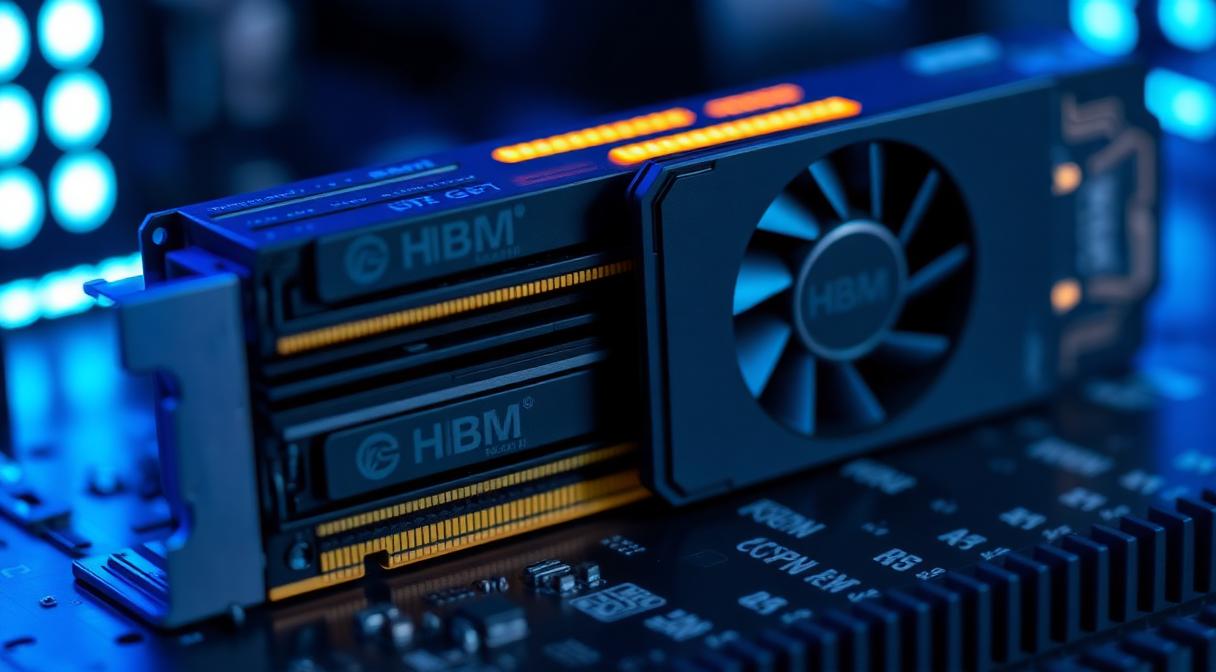
HBM supply has become a key bottleneck in the AI build-out. Image generated for editorial use.
The storage tier: Seagate and Western Digital
The data AI creates has to live somewhere, and for bulk storage that still means hard drives — a near-duopoly between two S&P 500 names.
Western Digital (WDC) is the nearline-storage scale leader. In fiscal Q3 2026 (ended around April 2026) it reported revenue of roughly $3.3 billion, up about 45% year over year, with nearline capacity shipped up sharply, according to its results. Its edge is execution and discipline: its 2026 high-capacity drive output is effectively sold out under long-term agreements with Microsoft, Meta, and Amazon, and rather than building more drives it is raising the capacity of each one. The risk is the familiar one — storage is cyclical, and with the stock having re-rated hard, analyst price targets have at times sat below the share price, a sign much of the near-term upside may already be reflected.
Seagate (STX) is the other half of the duopoly, competing on areal density through its HAMR technology, which packs more data onto each platter. It posted record revenue in its fiscal Q2 2026 (ended early January 2026), with 2026 nearline capacity fully booked and visibility extending into 2027. Its edge is that density leadership; its risk is execution — Seagate's results have historically been more volatile, and the payoff depends on ramping HAMR cleanly.
The cyclicality question
Everything in this layer turns on one debate: is this time different? Memory and storage are textbook cyclical businesses. Demand outruns supply, prices spike, producers race to add capacity, supply overshoots, and prices crater — the cycle has repeated for decades.
The bull case for a structural break rests on three things: HBM is custom-engineered and tightly qualified rather than a swappable commodity; supply for 2026 is largely sold out under multi-year agreements that lend revenue visibility the industry has rarely had; and AI demand is still climbing as models grow more memory-hungry. The bear case is that none of that repeals the cycle — capacity is being added aggressively across the industry, and if AI spending moderates or efficiency gains reduce memory intensity, the same boom-bust dynamic could reassert itself. Both readings are live, and the honest answer is that the super-cycle's durability is still unproven.
Equity markets price in macro shifts, earnings and policy in real time. Image generated for editorial use.
What this layer feeds
Memory is the quiet kingmaker of the stack. It exists to keep the chips fed, it is made possible by the advanced-packaging tools of the equipment makers, and its rising cost flows straight into the budgets of the hyperscalers building everything above it. For the full picture, start with the series overview.
This article is for information only and is not investment advice or a recommendation to buy or sell any security. TradeRadarNews is not a licensed financial adviser. Figures are accurate as of June 2026 and will change. Do your own research.
Risk Warning: Trading and investing carries significant risk. Your investments can fall as well as rise. CFDs carry high risk of rapid loss due to leverage. Cryptocurrency is not ASIC-regulated and not covered by AFCA. This is information only, not financial advice. Seek independent advice before investing.
Written by
TradeRadarNews Team
Editorial Team
Our editorial team covers markets, fintech, and regulatory developments across Australia and globally.
Advertisement. Your capital is at risk when trading. Not financial advice.
Risk Warning: Trading and investing carries significant risk. Your investments can fall as well as rise. CFDs carry high risk of rapid loss due to leverage. Cryptocurrency is not ASIC-regulated and not covered by AFCA. This is information only, not financial advice. Seek independent advice before investing.