No AI chip exists until someone builds the machines that make it. Meet the semiconductor equipment stocks — Applied Materials, Lam Research, and KLA — that sell the tools behind every accelerator.
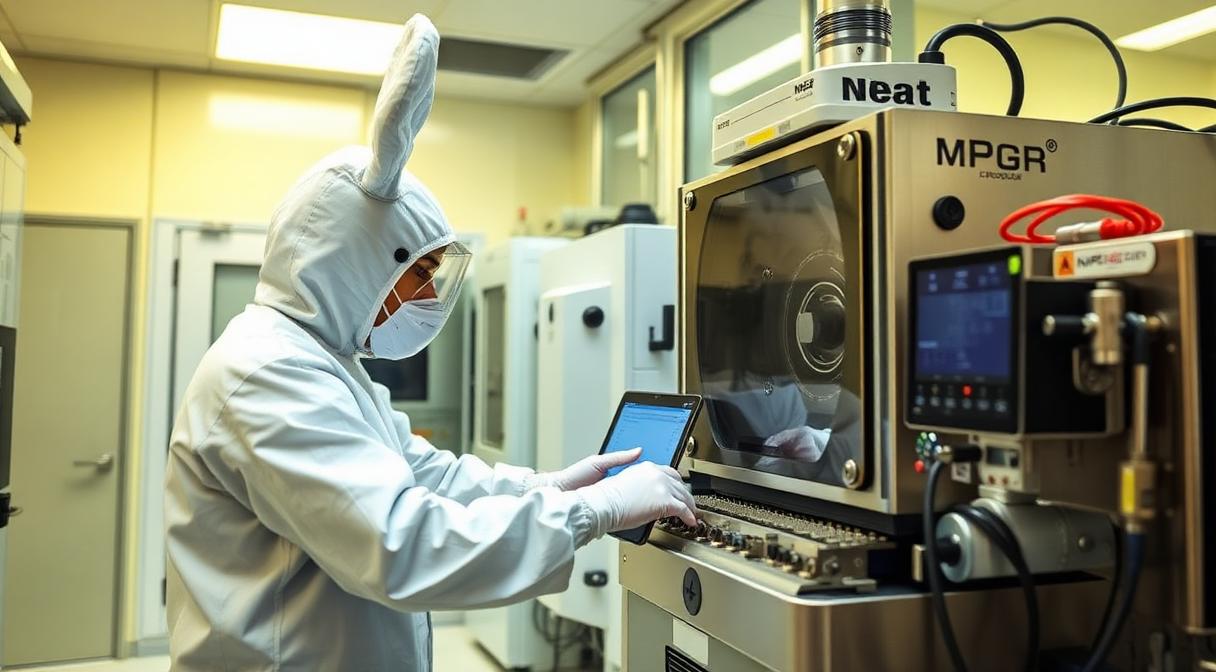
The story of AI usually starts with the chip. But a chip is the output of a production line, and that line is built and equipped by a different set of companies — the ones that make the machines that etch, deposit, pattern, and inspect silicon at the atomic scale. This is the most upstream layer of the whole stack: before a single accelerator can be designed or sold, the tools to manufacture it have to exist and be installed. When AI demand surges, it shows up here first, in orders for equipment that will not produce a finished chip for many months.
Where this sits in the stack. The equipment makers sit below the chips and the memory in the AI infrastructure stack — they are what make both layers physically possible. Nothing above them gets built until their machines are running on a fab floor.
How a chip gets made
Turning a blank silicon wafer into an AI accelerator takes hundreds of precise steps, but they fall into a few families. Deposition lays down ultra-thin films of material. Etch carves patterns into those films. Lithography prints the circuit design (the single most specialized step). And process control — inspection and metrology — checks each wafer for defects, which matters more as features shrink. Each family maps to a company, and AI is concentrating spending in the hardest, most advanced versions of all of them: leading-edge logic, the DRAM behind high-bandwidth memory, and the advanced packaging that stacks chips together.
One name dominates lithography but sits outside this series' frame: ASML, a Dutch company, holds an effective monopoly on the EUV machines every leading-edge chip passes through. It is not an S&P 500 member, so it appears here only as context — but it is the single hardest chokepoint upstream of everything.
Applied Materials: the broad-line leader
What it does. Applied Materials (AMAT) is the most diversified toolmaker, with leading positions across deposition, etch, and several other process steps rather than dependence on any one.
The numbers. In fiscal Q1 2026, Applied reported revenue of about $7.01 billion with gross margin of 49.1%, its highest in 25 years; by fiscal Q2 2026 revenue was roughly $7.91 billion, up about 11% year over year, per its results. Management raised its outlook for 2026 semiconductor-equipment growth to more than 30%, and expects advanced-packaging revenue to grow above 50% for the year.
The edge. Breadth. Applied estimates that leading-edge logic, DRAM, and advanced packaging will drive more than 80% of equipment-market growth in 2026 — and it sells into all three. Customers are now giving it multi-quarter forecasts, rare visibility in a cyclical business.
The risk. Wafer-fab equipment has always been cyclical, and US export controls have cut off much of the China market. A pause in capacity additions would hit Applied quickly.
Lam Research and KLA: etch, deposition, and inspection
Lam Research (LRCX) specializes in etch and deposition, with particular strength in memory. It raised its 2026 wafer-fab-equipment-spending outlook to roughly $140 billion, and its CEO has described that figure as carrying a bias to the upside, citing AI demand across logic, HBM, and storage. Its edge is depth in the exact process steps the memory super-cycle (see The Memory) is driving hardest. Its risk is the mirror image: more memory-concentrated than its peers, so more exposed if the memory cycle turns.
KLA (KLAC) owns process control — the inspection and metrology step. In its fiscal second quarter of 2026 (reported in January) it posted revenue of about $3.3 billion at industry-leading margins, roughly 63% gross and 44% operating, per its release. Its edge is close to a monopoly: about 90% of its revenue comes from process control, and every leading-edge wafer is checked with its tools — a position that strengthens as chips grow more complex and advanced packaging adds inspection steps. Its risk is that, as a supplier to the whole industry, it rides the overall capital-spending cycle; a broad pullback would pull it down too.
The cyclicality question
The bull case for the toolmakers is that AI has changed the shape of the cycle. Each new chip generation needs more process steps, more inspection, and more advanced packaging, so the equipment intensity of every wafer keeps rising — and customer visibility has never been longer. The bear case is that "this time is different" is the most expensive phrase in semiconductors: equipment is the most cyclical link in the chain, China controls cap the market, and current valuations price in years of uninterrupted growth. Both readings have merit, and the layer's defining feature — that it leads the cycle in both directions — cuts both ways.
What this layer feeds
The toolmakers are the foundation under the foundation. Their machines make the chips and the memory that everything else in the stack depends on. For the full map, start with the series overview.
This article is for information only and is not investment advice or a recommendation to buy or sell any security. TradeRadarNews is not a licensed financial adviser. Figures are accurate as of June 2026 and will change. Do your own research.