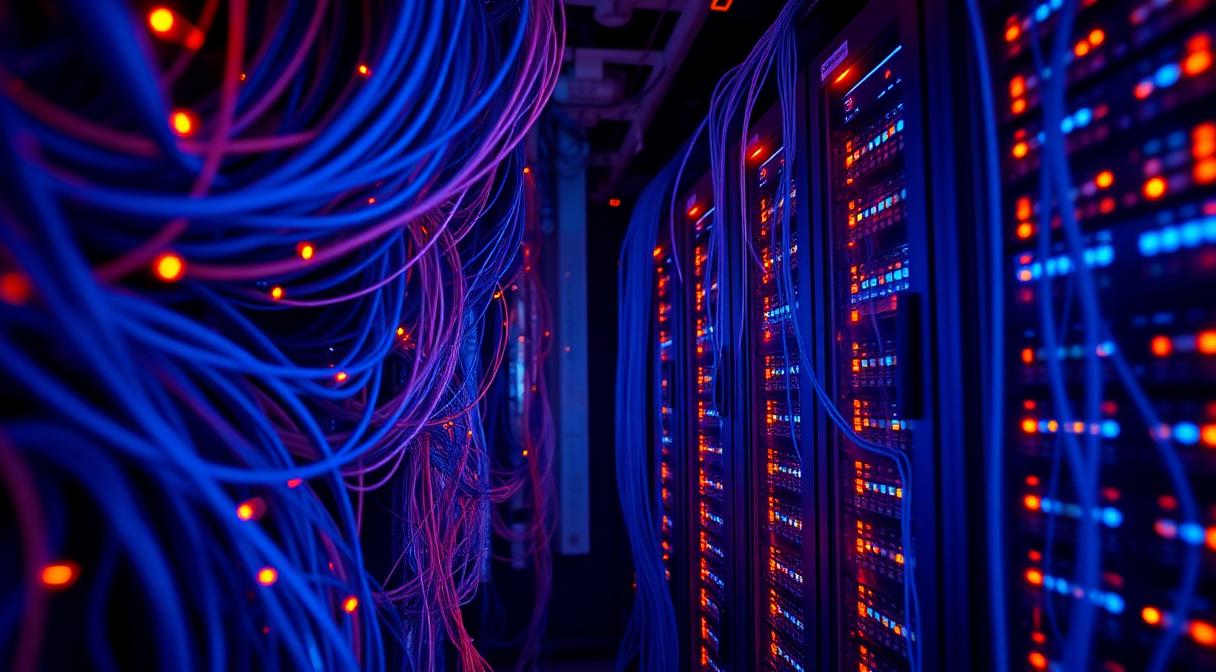
A cluster of a hundred thousand GPUs is useless if the chips cannot talk to each other fast enough. Meet the AI networking stocks — Arista, Cisco, Broadcom, and the optics makers — that turn racks of silicon into a single machine.
Training a frontier model does not happen on one chip. It happens across tens of thousands of them, working in concert, which only works if they can exchange data almost instantly. The layer that makes that possible — the switches, the silicon inside them, and the optical links that carry data as light between racks — is the least visible part of the AI build-out and one of the most essential. When people talk about a GPU "cluster," the network is the thing that makes it a cluster rather than a warehouse of disconnected chips.
Where this sits in the stack. Networking sits directly above the chips in the AI infrastructure stack and is bought in bulk by the hyperscalers. Its job is to turn raw compute into usable compute.
The two networks of an AI cluster
An AI data center runs two networks. The front-end network connects servers to storage and the outside world, much like ordinary data-center networking. The back-end fabric is the new and demanding part: it wires the accelerators directly to one another so they can share the intermediate results of a training run at enormous speed. That back-end is where AI-specific networking lives, and it is migrating fast from 800-gigabit to 1.6-terabit links. A long-running debate sits underneath it — whether that fabric should run on open Ethernet or on the rival InfiniBand standard — and the balance has been tilting toward Ethernet.
Arista: the switching leader
What it does. Arista (ANET) makes the high-speed switches at the heart of AI back-end fabrics.
The numbers. Arista reported full-year 2025 revenue of $9 billion, and first-quarter 2026 revenue of about $2.709 billion, up 35% year over year, per its release. It raised its 2026 growth outlook to 25% and lifted its 2026 AI-networking guidance to $3.25 billion.
The edge. Arista has overtaken Cisco in high-speed data-center switching share and expects to clear $10 billion in annual revenue in 2026. Its deeper moat is software: the EOS operating system its switches run on is something network engineers build around and rarely rip out.
The risk. Concentration. A large share of revenue comes from Microsoft and Meta, and Nvidia's competing Spectrum-X Ethernet platform could squeeze Arista out of new builds if it bundles networking with its GPUs.
Cisco and Broadcom: the incumbent and the silicon
Cisco (CSCO) is the networking giant reasserting itself after ceding Ethernet share. In its fiscal first quarter of 2026 it reported revenue of about $14.9 billion, up 8%, with networking up 15%, and it raised its fiscal-2026 AI-infrastructure revenue guidance from $2 billion to $3 billion. Its edge is scale, its enormous installed base, and software from the Splunk acquisition; its risk is that it must prove it can hold AI share against a faster-moving Arista.
Broadcom (AVGO) appears here as well as in The Chips, its home in this series. On the networking side it supplies the silicon inside many switches — its Tomahawk family now reaches 100 terabits per second — and AI networking is a growing slice of its AI revenue. Its risk in this layer is the same margin tension described in the chips piece, where custom and networking silicon carry different economics.
The optics layer
As clusters grow, copper hits its distance limits and data has to travel as light. Two S&P 500 names — both added to the index in March 2026 — sit at this bottleneck. Lumentum (LITE) is the standout: revenue rose more than 65% year over year to roughly $665 million in its latest quarter, with guidance for around 90% growth the next, and it is the only company shipping the 200-gigabit-per-lane laser chips that the 1.6-terabit transition requires, with demand outstripping supply. Coherent (COHR) is the other: its datacenter-and-communications segment grew about 41% to become roughly three-quarters of revenue. The risk for both is that they have re-rated sharply and lean on a handful of hyperscaler customers.
The concentration question
The bull case for the networking layer is that AI clusters keep scaling, Ethernet keeps winning the back-end, and the optics bottleneck hands suppliers real pricing power. The bear case is that the whole layer rests on a few hyperscalers, and the architecture is still in flux — copper versus optics, merchant switches versus in-house designs, and emerging co-packaged optics could all reshuffle the winners. The valuations, especially in optics, leave little room for a stumble. Both sides are live.
What this layer feeds
Networking is the connective tissue that turns the chips into a working machine, and it is bought by the hyperscalers building the clusters. For the full map, start with the series overview.
This article is for information only and is not investment advice or a recommendation to buy or sell any security. TradeRadarNews is not a licensed financial adviser. Figures are accurate as of June 2026 and will change. Do your own research.