You can buy all the GPUs you want — if you cannot power them, they are paperweights. Meet the AI power stocks supplying the one thing the whole build-out cannot manufacture: electricity.
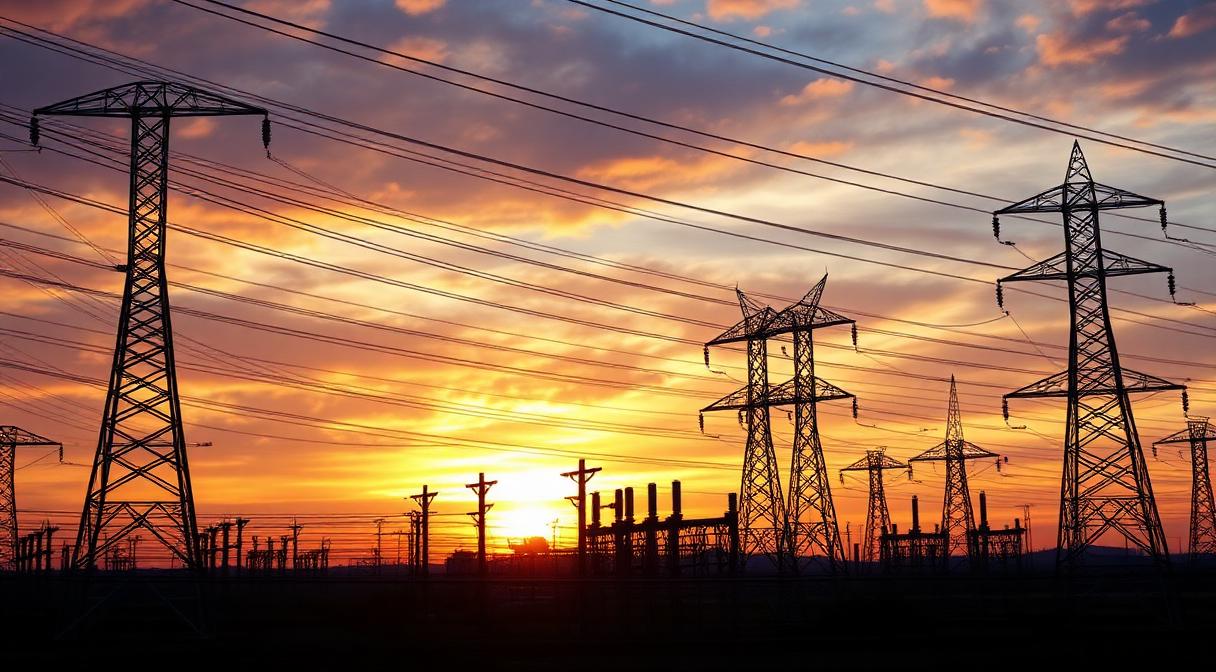
The constraint on AI in 2026 is not chips. It is power. After decades of flat electricity demand, data centers have triggered a step-change in how much power the grid must deliver, and the companies that generate and move that electricity have become some of the least obvious AI plays of all. Estimates put the investment needed for AI data-center electrification at around $1.4 trillion by 2030. This is the foundation the entire stack rests on — and, increasingly, the ceiling it keeps hitting.
Where this sits in the stack. The grid is the bedrock beneath the AI infrastructure stack. It powers the buildings, feeds the cooling and power systems inside them, and ultimately keeps the chips running. When the hyperscalers talk about being capacity-constrained, this is usually what they mean.
Why AI broke the power assumption
For a generation, US electricity demand barely grew, and utilities planned accordingly. AI changed that almost overnight: a single large data-center campus can require as much power as a small city, and it needs that power around the clock, which makes steady "baseload" generation — especially carbon-free nuclear — suddenly scarce and valuable. That scarcity has split the field into two kinds of company: operators that generate and sell electricity, and equipment makers that supply the hardware to build new capacity.
Constellation and Vistra: the operators
Constellation Energy (CEG) is the largest US nuclear operator, selling carbon-free baseload power directly to hyperscalers under long-term agreements. Its $26.6 billion acquisition of Calpine closed in early 2026, creating a roughly 55-gigawatt fleet, and its revenue has climbed sharply on data-center demand. Its edge is scarce, contracted, carbon-free baseload; its risk is counterparty exposure — those long contracts are only as good as the customers behind them — plus the work of integrating Calpine.
Vistra (VST) is a generator combining nuclear and natural gas, with long-term agreements to supply power to Amazon and Meta. Its edge is the mix of always-on nuclear plus flexible gas; its risk is commodity exposure and the same counterparty question.
GE Vernova: the equipment layer
What it does. GE Vernova (GEV) is not an operator but the technology layer — gas turbines, grid equipment, and small modular reactors — that gets new capacity built.
The numbers. GE Vernova signed more than $2 billion of data-center electrification orders in 2025, roughly triple the prior year, and management frames the company as serving only about 10% of its addressable market so far.
The edge. Gas turbines that bridge the gap while cleaner capacity is built, grid-modernization kit, and a small-modular-reactor program for the longer term.
The risk. Power projects run on multi-year timelines, and the order book has to convert through long, complex builds.
NextEra: renewables at scale
NextEra Energy (NEE) is the other supply lever — the largest US developer of renewables, paired with a large regulated utility, positioned to add grid-scale solar and storage to meet the new load. Its edge is scale in renewables and storage; its risk is that the binding constraint is often not generation but transmission — getting power from where it is made to where the data centers are — along with the usual rate and regulatory hurdles.
The distinction worth leaving readers with: operators like Constellation and Vistra make money selling electricity under long-term contracts, while GE Vernova makes money selling the equipment that builds the capacity. Different businesses, same tailwind.
The timing question
The bull case is that power is a structural bottleneck rather than a passing one, that long-term contracts lock in premium revenue for carbon-free baseload, and that the scarcity is real. The bear case is that power plants and transmission take years to build, that the same hyperscaler-and-OpenAI concentration seen elsewhere in the stack shows up again as counterparty risk in these contracts, and that financing the build-out strains balance sheets. This is the most macro-thesis layer in the series, and its biggest risk is simply time. Both sides hold.
What this layer feeds
The grid is the hard ceiling on everything above it. Every layer of the stack — from the chips up through the clouds — ultimately waits on the electrons this layer supplies. For the full map, start back at the series overview.
This article is for information only and is not investment advice or a recommendation to buy or sell any security. TradeRadarNews is not a licensed financial adviser. Figures are accurate as of June 2026 and will change. Do your own research.