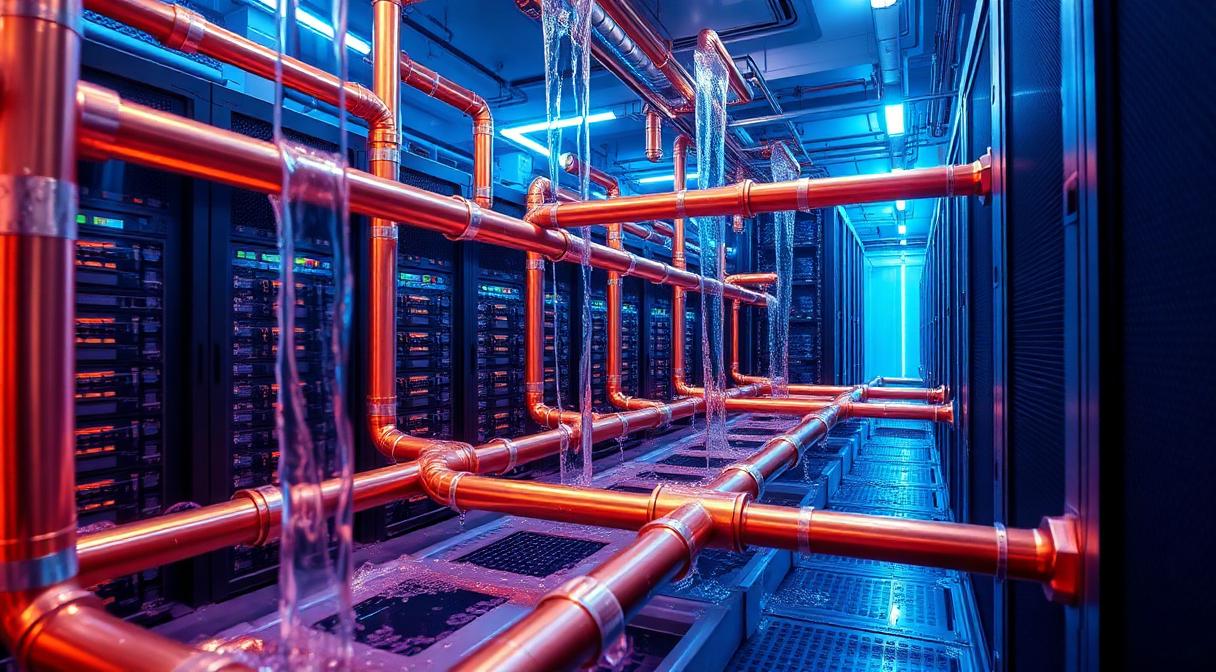
An AI rack can draw as much power as a small neighborhood and runs hotter than air can cool. Meet the data center cooling companies — led by Vertiv and Eaton — that keep the racks alive.
Inside the buildings is a physical problem most coverage skips: a rack of modern AI accelerators concentrates an extraordinary amount of power and heat into a small space. Densities have climbed to the point where blowing cold air across the chips is no longer enough, and operators are piping liquid directly to them. Delivering that power cleanly and carrying that heat away is its own industry — the layer of pumps, plates, busbars, and backup power that sits between the building and the chips. It is unglamorous and absolutely load-bearing.
Where this sits in the stack. This layer lives inside the buildings of the AI infrastructure stack, draws its power from the grid, and exists to keep the chips running safely.
Why density changed everything
For years data centers were cooled with air, like a very large server room. AI broke that. As power per rack has climbed, the heat produced has outrun what air can remove, so liquid cooling — circulating coolant directly to the hottest components — has moved from exotic to standard for the densest rows, running alongside traditional air cooling for the rest of the floor. At the same time, getting that much electricity to the rack reliably has made power distribution — uninterruptible supplies, switchgear, busbars — a growth business in its own right.
Vertiv: the pure-play
What it does. Vertiv (VRT) is the cleanest public proxy for data-center power and cooling, with roughly 80% of its revenue tied to data centers.
The numbers. First-quarter 2026 revenue was about $2.65 billion, with organic sales up 23% and the Americas up 44% organically; adjusted earnings per share rose 83%, per its results. The backlog stood above $15 billion, up 109% year over year, at a 2.9-times book-to-bill — meaning Vertiv is booking nearly three dollars of new orders for every dollar shipped. It raised full-year 2026 guidance to roughly $13.5–14.0 billion in revenue.
The edge. Leadership in liquid cooling, deepening ties to Nvidia's reference designs, and the credibility of joining the S&P 500 in March 2026.
The risk. The stock has re-rated hard on the AI thesis; the case now rests on the order book converting on schedule, and project timing can slip.
Eaton: the electrical layer
What it does. Eaton (ETN) is a broad electrical-infrastructure supplier, with roughly 70% of revenue in electrical segments, increasingly pulled by data-center demand.
The numbers. Eaton has cited unprecedented data-center demand, posted high-single-digit organic growth, and in March 2026 acquired Boyd Thermal to add liquid-cooling capability — a business projected to contribute on the order of $1.5–1.7 billion in 2026.
The edge. A far broader electrical portfolio than a pure-play, now extended into cooling, with a planned spin-off of its vehicle unit to sharpen focus.
The risk. Data center is one slice of a diversified industrial business, so even strong segment growth is diluted at the company level.
The valuation question
The bull case is the order book itself: backlogs, book-to-bill ratios above two, and a structural shift to liquid cooling that is still early. The bear case is that these names have run hard, trade at rich multiples, and depend on hyperscaler capex staying elevated and projects landing on time. Both are defensible; the physics of the heat problem is not in doubt, but the timing and the valuation are.
What this layer feeds
This hardware keeps the chips alive inside the buildings, drawing on the grid to do it. For the full map, start with the series overview.
This article is for information only and is not investment advice or a recommendation to buy or sell any security. TradeRadarNews is not a licensed financial adviser. Figures are accurate as of June 2026 and will change. Do your own research.